


The wording is familiar. The urgency is always absolute. The implication is unmistakable: Israel is not choosing war. It is forced into it.
For many, the claim is inherently contradictory. How can a state initiate war – and in Gaza’s case, sustain a genocide – while insisting that it is merely defending itself from annihilation? Yet within Israeli political discourse, and across much of Western media, this contradiction is rarely interrogated. It is normalized.
That normalization is not incidental. It is foundational.
Dimona is not an ordinary town. It lies adjacent to the Negev Nuclear Research Center, widely understood to be central to Israel’s nuclear weapons program.
Located deep in the Naqab desert, the facility has long been treated as one of Israel’s most sensitive strategic sites, associated with plutonium production and long-term weapons capability.
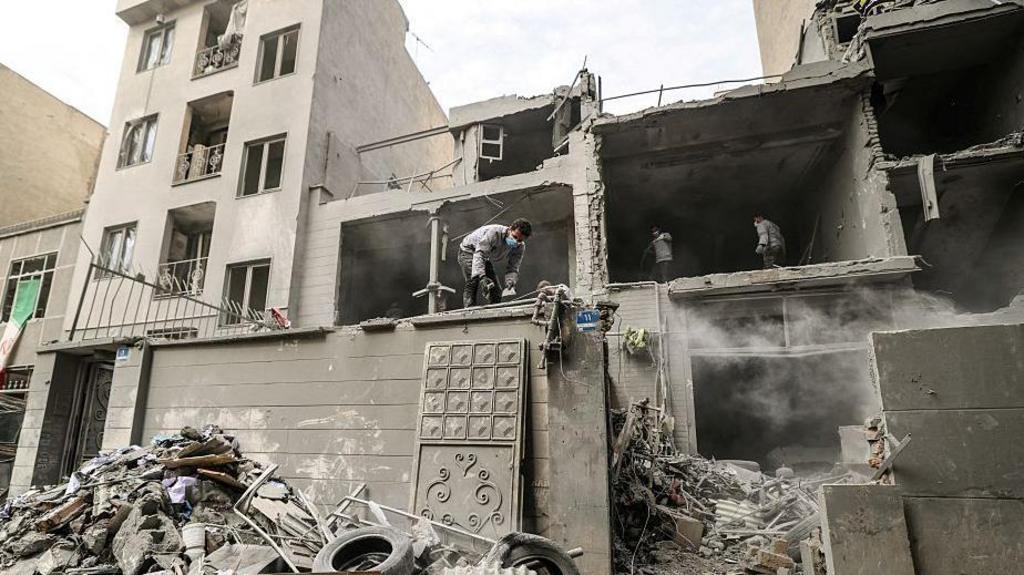
That context gives the strike its meaning. The Iranian attack on Dimona came hours after a renewed US-Israeli strike on Iran’s Natanz nuclear facility earlier the same day.
According to international and Iranian reports carried by Reuters, the Natanz enrichment complex in Isfahan province was targeted on the morning of March 21, with the International Atomic Energy Agency confirming damage but no radiation leak.
The sequence is not incidental. Natanz was struck in the morning; Dimona was hit later the same day. Even without an exact hour-by-hour timeline, the proximity establishes a clear operational logic: a nuclear facility in Iran is answered with a nuclear-adjacent site in Israel within hours.
Since the beginning of the war on February 28, 2026, Iran has followed a consistent pattern. Every escalation is met with escalation, and every strike on strategic infrastructure is answered with pressure on equally strategic targets.
This breaks from the historical pattern of US and Israeli wars in the Middle East, where escalation largely flowed in one direction.
For decades, Washington and Tel Aviv defined the tempo and limits of conflict. Others absorbed, recalibrated, and survived. Iran has challenged that model by redistributing vulnerability across the battlefield – expanding the geography of confrontation and refusing to remain within predefined limits.
Today’s events illustrate this shift with unusual clarity. The targeting of Natanz and the subsequent strike on Dimona form part of a single chain of escalation, not separate incidents. The battlefield is no longer fragmented; it is structurally connected.
The intellectual roots of this approach, however, lie partly in Israeli military doctrine itself. During the 2008–2009 war on Gaza, then-foreign minister Tzipi Livni articulated this logic in unmistakable terms.
“Israel is not a country upon which you fire missiles and it does not respond. It is a country that when you fire on its citizens it responds by going wild – and this is a good thing.”
She was even more explicit in a separate statement: “Israel demonstrated real hooliganism during the course of the recent operation, which I demanded.”
These were not slips of language. They were declarations of doctrine.
The idea was simple: overwhelming, disproportionate, and seemingly uncontrolled force would deter adversaries by making the cost of confrontation unbearable. Israel would not merely respond; it would escalate beyond predictability.
For years, that doctrine functioned largely in one direction. Israel could escalate with overwhelming and unpredictable force, while others were expected to absorb the consequences and recalibrate. The logic was not simply military, but psychological – deterrence through excess, through the projection of a state willing to go beyond conventional limits.
A similar logic had already been articulated decades earlier in the United States through what became known as the “madman theory,” associated with Richard Nixon. The idea was that a leader’s unpredictability – even the perception of irrationality – could itself function as a tool of coercion.
Under Donald Trump, that posture did not emerge for the first time but reappeared in a more overt and performative form, where unpredictability was framed not as risk, but as leverage, and at times deliberately amplified.
But Iran appears to have internalized this logic and turned it outward. The strike on Dimona is not only retaliation. It is replication. Tehran is applying the same doctrine back onto its originators, transforming deterrence into a shared and unstable framework.
Strike Natanz, and Dimona is no longer untouchable. Expand the battlefield, and the battlefield expands further. What was once a one-sided doctrine of domination becomes a two-sided mechanism of escalation.
This dynamic has unsettled Washington. US media, citing intelligence assessments, reported in mid-March that the Trump administration had been warned of Iranian retaliation, yet the scale and coordination of the response exceeded expectations.
On March 21, even as military operations continued, Trump indicated that Washington was considering options to “wind down” the war, even as additional forces were deployed. Retreat would signal a geopolitical defeat; escalation risks a deeper one.
Israel faces a different but equally dangerous reality. For Prime Minister Benjamin Netanyahu, escalation has often functioned as a strategy, prolonging conflict and delaying internal crises. But Iran’s adoption of the same escalation logic complicates that approach.
When both sides embrace escalation as a principle, deterrence begins to erode.
Iran, however, appears to be operating with a longer horizon. Its capabilities extend beyond missile exchanges to include influence over maritime chokepoints, regional alliances, and actors capable of exerting pressure across multiple fronts.
Among these is the Bab al-Mandeb Strait, where Ansarallah maintains the ability to disrupt global shipping. This adds another layer to a conflict already expanding beyond conventional battlefields.
Some of Iran’s capabilities are visible. Others remain deliberately undefined. This allows Tehran to escalate while preserving strategic depth, maintaining pressure without exhausting its options.
Ironically, the doctrine now shaping the war is one Israel helped normalize.
On March 21, with Natanz and Dimona linked within the same day of strikes, that transformation became unmistakable. The war is no longer defined by who escalates – but by what happens when both sides choose, deliberately, to ‘go wild’.
Read the full article here