


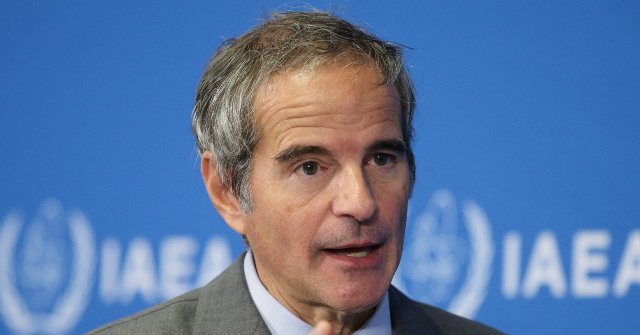
International Atomic Energy Agency (IAEA) Director-General Rafael Grossi said on Sunday that Iran’s nuclear program has sustained “enormous damage,” but warned “elements that were not destroyed persist” in the wake of both last summer’s massive U.S. airstrikes and the current war in Iran.
Grossi told CNN host Fareed Zakaria that Iran’s nuclear ambitions have suffered major setbacks but have not been completely eliminated.
“There was enormous damage, in particular during the 12-Day War last year, at Isfahan, Natanz, and Fordow,” he said, referencing Iran’s three main uranium enrichment sites.
Grossi said the month-long Operation Epic Fury has included “targets and objectives that go far beyond the range of the nuclear field,” but even combined with the damage from last year’s strikes, “not everything was destroyed.”
Grossi also agreed with Zakaria’s observation that one “cannot bomb the knowledge away,” or eliminate Iran’s intellectual progress toward nuclear weapons with an aerial bombing campaign.
“Don’t forget that this activity of uranium enrichment, which is rather complex, is not something that is impossible to do. The methodology is quite sophisticated. The centrifuges that spin at high velocity, to separate the isotope of uranium which is interesting from the one which is not – all of these things Iran has mastered over the years,” he said.
Grossi noted that uranium enrichment is “not, per se, a nuclear activity,” and if the Iranians are patient enough, it can be conducted in small-scale operations that would be difficult to hunt down and destroy.
“You may have, in Iran, thousands – or perhaps more – of workshops, or small factories, where they could reproduce these capacities,” he said.
Grossi agreed with U.S. intelligence estimates that the U.S. stealth-bomber strikes against Isfahan, Natanz, and Fordow inflicted “very considerable” damage, pushing Iran’s nuclear program back for years, but he said “there are things that remain.”
Zakaria argued that this analysis contradicted “the administration’s current claims” that if Operation Epic Fury had not been initiated, Iran could be only a few weeks or months away from putting a nuclear bomb together.
Grossi said he was not privy to the intelligence data behind those claims, but he reminded Zakaria that Iran’s “stockpile of enriched uranium” appears to have survived the 12-Day-War.
“It is true that the program had reached a concerning level of development,” he said.
The IAEA director disagreed with Iran’s assertions that it has a “right to enrichment,” and expressed some sympathy for the U.S. desire to restrict Tehran to “very limited enrichment activities” under IAEA supervision.
“Perhaps a suspension of these activities could be agreed for a few years, without Iran resigning permanently, as part of a trust-building process,” he suggested.
Grossi was reluctant to either endorse or condemn the U.S-Israeli action against Iran, restating his preference for negotiations under almost any circumstances.
He spoke well of Iran’s negotiators, saying they are “extremely intelligent and defend their positions, just as the United States and Israel do,” although he has expressed some exasperation in the past with Iran’s refusal to fully comply with its inspection obligations.
The IAEA said on Sunday that Iran’s heavy water plant at Khondab has “suffered severe damage and is no longer operational.” Heavy water is not itself a nuclear material, but it is vital to nuclear research and power plant construction. Khondab was hit by an Israeli airstrike on Friday.
Read the full article here