


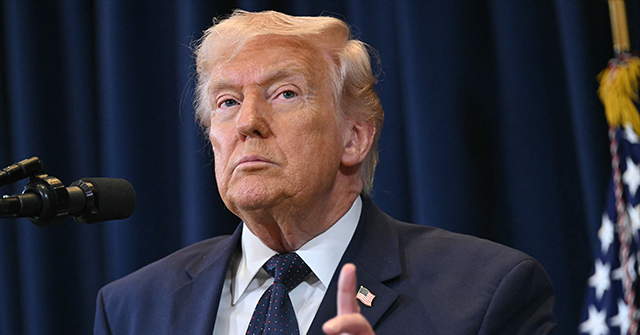
President Donald Trump suggested in a message on Monday morning that a “NEW, AND MORE REASONABLE, REGIME” has taken over Iran and is talking to Washington – but warned he was willing to “obliterate” Iran’s energy infrastructure if talks did not lead to a durable agreement.
Trump made the declaration in a message on his website, Truth Social. What remains of the Iranian government after the elimination of “supreme leader” Ayatollah Ali Khamenei has repeatedly denied Trump’s claims that it is in conversation with the American government, while also stating that it has responded to American proposals, which would be impossible without a conversation.
In his statement on Monday, Trump suggested that, not only is America pursuing regime change in Iran, but that regime change had already happened.
“The United States of America is in serious discussions with A NEW, AND MORE REASONABLE, REGIME to end our Military Operations in Iran,” Trump wrote. He followed up this comment with a threat.
“Great progress has been made but, if for any reason a deal is not shortly reached, which it probably will be, and if the Hormuz Strait is not immediately ‘Open for Business,’” he continued, “we will conclude our lovely ‘stay’ in Iran by blowing up and completely obliterating all of their Electric Generating Plants, Oil Wells and Kharg Island (and possibly all desalinization plants!), which we have purposefully not yet ‘touched.’”
“This will be in retribution for our many soldiers, and others, that Iran has butchered and killed over the old Regime’s 47 year ‘Reign of Terror.’ Thank you for your attention to this matter,” he added.
While the Iranian government has not responded directly to Trump’s statement at press time, Foreign Ministry spokesman Esmaeil Baghaei confirmed on Monday that Iran had received and was contemplating negotiation messages from the United States. He disparaged the proposals as “unrealistic, illogical, and excessive,” but his statement nonetheless confirmed the existence of some form of communication between individuals in power in Iran and the White House.
“Our position is clear. We are under military aggression. Therefore, all our efforts and strength are focused on defending ourselves,” Baghaei he declared, according to a translation by the Saudi outlet Al Arabiya.
The government of Pakistan claimed last week that it was mediating talks between America and Iran, handing Tehran a 15-point proposal from the White House. Trump shortly thereafter claimed that Iran “gave us most of the points” and that he would “be asking for a couple of other things.” The president also announced that he would not target any energy infrastructure in Iran through April 6, Easter Sunday.
“Talks are ongoing and, despite erroneous statements to the contrary by the Fake News Media, and others, they are going very well. Thank you for your attention to this matter!” the president said on Thursday. He also claimed that Iran was “begging for a deal,” contrary to the declarations in Iranian state media.
Also indicating the existence of talks was the head of the International Atomic Energy Agency (IAEA), Rafael Grossi, who told Italian media on Wednesday that talks about the Iran war would take place in Pakistan as early as this past weekend.
RELATED: Sen. Cotton — China, Iran Are Allies in Fighting U.S. Leadership of International Order
“Three weeks of war that have left their mark. Which caused a lot of damage, affected Iran’s economic, energy, and productive infrastructure,” Grossi posited. “This will make the conversation a little different.”
Pakistan did host talks on the Iran war this weekend, but reports indicate that neither Iran nor the United States participated. Instead, the event offered an opportunity for Pakistan to discuss the war with officials from Saudi Arabia, Turkey, and Egypt.
According to the Egyptian Foreign Ministry, the objective of the talks is to “de-escalate tension and encourage a negotiating process between Iran and the United States to spare the region comprehensive chaos.” The Pakistani government also added that, while Iran did not directly participate, Pakistani officials held a phone call with Iranian Foreign Minister Abbas Araghchi to discuss Tehran’s position.
Most of Iran’s response to the current hostilities by the United States has been to target its neighboring countries with missile and drone attacks, including Saudi Arabia and Turkey. Other countries Iran has bombed include Kuwait, Qatar, the United Arab Emirates (UAE), Israel, Azerbaijan, and Cyprus. Iranian officials have claimed the strikes are intended to target American and Israeli sites, but in reality they have targeted a variety of civilian sites, including energy facilities in many Gulf States.
Follow Frances Martel on Facebook and Twitter.
Read the full article here