


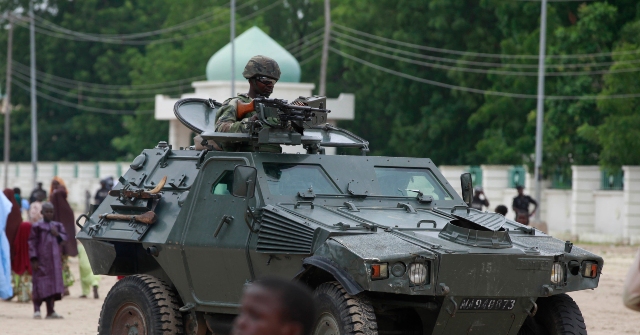
Multiple reports in the past week have indicated that the U.S. military has deployed surveillance drones to operate in Nigeria, in conjunction with the nation’s government, to gather intelligence on the various jihadist terrorist groups in the country.
The Associated Press (AP) reported on Monday that the drones are MQ-9, or Reaper, drones that “can fly at altitudes over 40,000 feet and can loiter for more than 30 hours.” A Nigerian military official suggested that Reaper drones were flying in the country in a report published by the Agence France-Presse (AFP) on March 21. The AP cited an alleged American official as the source for its report, and added an official comment from the Pentagon’s African Command (AFRICOM) stating that the Americans are “working alongside their Nigerian counterparts to provide intelligence support, advisory assistance, and targeted training in support of the Nigerian Armed Forces.”
The AFP report, as relayed in Nigerian media, claimed that a limited number of American forces on the ground were helping the Nigerian military and the drones in question were being operated out of an air base in Bauchi state.
“U.S. support is designed to enhance Nigeria’s ability to independently detect, track, and disrupt terrorist activity,” Nigerian Major General Samaila Uba told AFP. “This partnership has improved intelligence sharing, operational coordination, and the overall effectiveness of Nigerian-led efforts against violent extremist organizations.”
AFRICOM Commander Gen. Dagvin R.M. Anderson revealed in February that the American government had deployed a “small U.S. team that brings some unique capabilities” to Nigeria’s fight against jihadist terrorism.
“That has led to increased collaboration between our nations, to include a small U.S. team that brings some unique capabilities from the United States in order to augment what Nigeria has been doing for several years,” he explained at the time. Reports do not indicate that the Americans are operating on the front lines of combat.
The deployment of the Reaper drones, the Nigerian outlet The Cable assessed on Wednesday, was a “quiet but consequential shift in West Africa’s security landscape.”
“In north-eastern Nigeria, where insurgents exploit mobility, fragmented terrain, and porous borders, this fills a long-standing operational gap,” the newspaper observed, adding that the growing Pentagon presence in Nigeria also benefitted America because, “following the withdrawal of U.S. forces from Niger in 2024, Washington lost a key surveillance hub in the Sahel. The relocation of ISR capabilities to Nigeria reflects an effort to maintain regional visibility rather than expand territorial influence.”
The use of some of the Pentagon’s most advanced technology in Nigeria follows a period of some tension between President Donald Trump and Nigeria’s President Bola Tinubu in the later months of 2025 following the American head of state’s decision to return Nigeria to the State Department’s list of Countries of Particular Concern (CPC) for religious freedom. The designation, which Trump announced on October 31, raised awareness of the “existential threat” that Christianity faces in Nigeria at the hands of a host of genocidal terrorist organizations, primarily Boko Haram in the northeast and the Fulani terrorists plaguing the Middle Belt region.
Nigerian officials initially responded to the designation by denying the existence of any discrimination anywhere in the country, in particular anti-Christian sentiment, despite human rights organizations for years ranking Nigeria as the deadliest place to identify as a Christian. Tinubu himself claimed in early November that “the characterization of Nigeria as religiously intolerant does not reflect our national reality.” Contrary to this claim, hundreds of Christians are killed annually in the country in attacks intended to exterminate them from their native land.
“Nigeria has been at the maximum violence score (16.7 out of 16.7) for eight consecutive years,” Ryan Brown, the Open Doors CEO, told Breitbart News in January. “During our most recent reporting period, 3,490 Nigerian Christians were killed because of their faith — the highest number of any country and an increase from 3,100 the previous year.”
In the face of Nigeria’s public refusal to acknowledge the problem, Trump announced on Christmas Day that he had ordered a “powerful and deadly strike” on jihadists in northwest Nigeria.
“I have previously warned these Terrorists that if they did not stop the slaughtering of Christians, there would be hell to pay, and tonight, there was,” Trump announced. “Under my leadership, our Country will not allow Radical Islamic Terrorism to prosper. May God Bless our Military, and MERRY CHRISTMAS to all, including the dead Terrorists, of which there will be many more if their slaughter of Christians continues.”
The Nigerian government later clarified that it had been notified and was cooperating with the United States — the strikes were not, it insisted, a unilateral American action or a violation of Nigeria’s sovereignty. Tinubu described the strikes as a sign of Abuja taking the jihadist threat seriously and collaborating productively with the United States.
“In collaboration with international partners, including the United States, decisive actions were taken against terrorist targets in parts of the Northwest on December 24. Our Armed Forces have since sustained operations against terror networks and criminal strongholds across the Northwest and Northeast,” Tinubu said in his end of year presidential address.
Read the full article here