


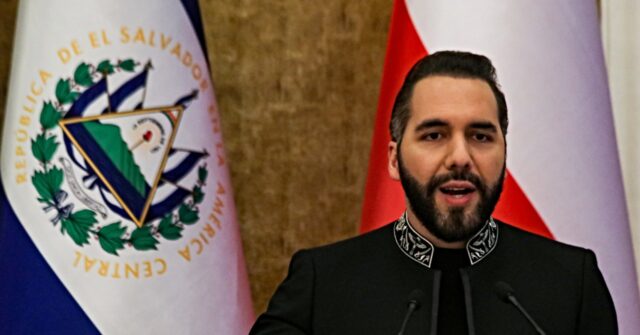
Vice President of El Salvador Félix Ulloa told the Spanish newspaper ABC that Nayib Bukele’s success is a “slap in the face” to “incompetent” Latin American leftists tied to European self-declared progressives.
On Wednesday, ABC published an interview it conducted with Ulloa on the sidelines of his recent official visit to Spain.
The visit part of a broader tour across Europe that saw the Vice President travel to Spain, Belgium, and France seeking to promote international cooperation with El Salvador and defend President Bukele’s security policies and crackdown against violent gangs amid criticism from EU member states.
ABC published the interview days before El Salvador marks the fourth year since President Bukele signed a still-active state of emergency decree in March 2022 that allowed the Salvadoran government to conduct a widespread crackdown against the nation’s most violent criminal gangs, such as MS-13 and 18th Street. The decree has been continuously renewed on a monthly basis since 2022.
Speaking to ABC, Ulloa stated that El Salvador had to “declare war” against the gangs to deal with the out of control violence, and that now that the country has a “security miracle” the government is aiming to attain an “economic miracle” marked by development and growth.
He noted that the “Bukele Model,” while it has become a reference, cannot be repeated because in order to do so, the conditions that existed in El Salvador must be present in other nations.
“First and foremost, there must be leadership like that of Nayib Bukele. Second, his actions must be supported by Congress and a judicial branch that enforces the laws enacted by the legislature,” Ulloa said.
ABC told Ulloa that “behind that economic and security miracle lies a dark side: the state of emergency,” to which the Vice President reportedly responded, “You say its’s a shadow — to whom? The majority of the population supports it.”
“There are still [gang] remnants, and that’s what people see. That’s why Salvadorans don’t want it lifted. The state of emergency doesn’t affect the general public,” Ulloa asserted.
Ulloa, citing statistics from a local opposition newspaper, asserted that 97 percent of Salvadorans “want to maintain” the state of emergency — and emphasized, “Are we really going to take it down just because some NGO or newspaper in Europe says so?”
Asked if Bukele seeking a third term would “consolidate the structures of corruption,” Ulloa dismissed the notion by asserting that there is no risk of corruption if its fought, he also dismissed concerns over Bukele’s tenure in power by referencing the time Felipe González served as Prime Minister of Spain and Angela Merkel in Germany.
“Bukele comes from the left, from the FMLN. When he criticizes the left and calls them corrupt, and they turn on him, he is breaking with a tradition of left-wing parties — all of which are corrupt,” Ulloa said.
“That is the Latin American progressive establishment that has ties to European progressives, and they are the ones attacking Bukele because he has succeeded in achieving peace, development, and popular support,” he continued.
“That frustrated, corrupt left is the one getting coverage in the media because Bukele’s success is a slap in the face to the corrupt and incompetent left,” he concluded.
Read the full article here