


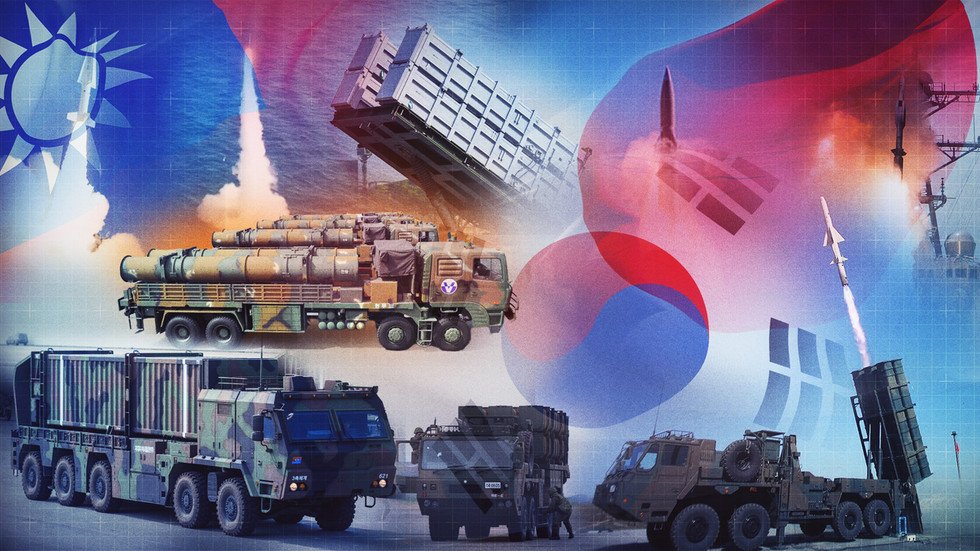
Facing pressure from China and North Korea, three US-aligned powers are rapidly expanding their capabilities along distinct strategic paths
The prospect of a major conflict in East Asia is no longer confined to strategic forecasts, as military planning across the region increasingly reflects scenarios involving China and North Korea. In response, countries closely aligned with the United States – Japan, South Korea, and Taiwan – are accelerating the development of missile capabilities that would play a central role in any such confrontation. Expanding strike ranges, improving survivability, and preparing for operations across land and sea are becoming integral to their defense strategies, shaped by the expectation that future crises may unfold rapidly and with little room for hesitation.
Three of the region’s most technologically advanced economies are increasingly investing in missile capabilities that reflect not only their industrial potential, but also a shared perception of escalating risk along their borders and across nearby seas. Decisions made in these capitals are beginning to translate into longer ranges, more flexible strike options, and systems designed for scenarios that, until recently, remained largely theoretical.
But today we will explore how Tokyo, Seoul, and Taipei are shaping their missile forces in response to these pressures – and what distinct strategic models are now emerging across East Asia.
Japan: From constraints to strike capabilities
Since 1970, Japan has possessed the technology to launch payloads to Low Earth Orbit. In fact, Japan became the fourth country in the world (following the USSR, the US, and France) to successfully deploy its own satellite using a domestically developed rocket. In this respect, it has outpaced China and the United Kingdom. Today, Japan has its own spaceport and several variants of launch vehicles for deploying satellites of various kinds. Despite this advanced capability, constitutional principles established after the Second World War impose strict limitations on the development of offensive weapon systems, particularly ballistic missiles. Recently, however, Japan has considered lifting these restrictions due to the growing military capabilities of neighboring China and North Korea.
Japan also develops missile defense systems, since this does not contradict its “non-offensive” and “non-nuclear” status, and has made significant progress in missile defense technologies. The country has developed several air defense systems and maintains an integrated missile defense program, which includes ballistic missile interception technologies acquired from the United States, later refined and integrated into its national defense systems. The primary component is the American Patriot missile defense system.
Additionally, Japan boasts a robust naval force and possesses Aegis system-equipped vessels. Aegis is notable for its SM-6 missiles, which can target not only aerial and ballistic threats but also strike ground targets. Japan is one of the few countries that possess such systems. While Aegis launch platforms can theoretically deploy Tomahawk cruise missiles, Japan does not currently possess these weapons.
In the past two to three years, Japan has initiated its own program for developing anti-ship missiles based on the Type 12 surface-to-ship missile which has a range of up to 200 km. By 2024, successful tests of an improved version with an expected range of 900 to 1,000 km were completed, with future plans to extend the range to 1,200 km. Discussions are underway to deploy the missiles on Japanese islands in order to provide fire support for Taiwan in the event of a Chinese invasion. The first units are expected to be deployed in the coming weeks and months; this has already provoked a sharply negative response from China.
READ MORE:
Pyongyang’s missile revolution: The most dangerous program you’re not paying attention to
Efforts are also underway to create a new cruise missile with a range of up to 1,500 km, designed for launch from both ships and aircraft. Technically, this missile’s range could be extended to 2,000-3,000 km. Modeled after the American Tomahawk missile, it is set to become part of Japan’s arsenal by the end of the 2020s.
Times are changing, however, and Japan has recently confirmed its development of the Hyper-Velocity Gliding Projectile (HVGP) hypersonic ballistic missile system, with plans for deployment in 2026-2027. The initial version is expected to have a range of about 1,000 kilometers, with future developments aimed at extending that range to 3,000 kilometers. There is no doubt that Japan can successfully create such a missile system. The primary catalyst for the shift in Japan’s policy is the increasing military power and ambitions of China and North Korea.
South Korea: Building a full-spectrum missile force
In contrast to Japan, South Korea has no self-imposed political restrictions on missile technology. The country finds itself in a constant state of tension with its neighbor, North Korea. South Korea is committed to maintaining non-nuclear status, and began developing its own operational-tactical missile systems in the early 2000s. Technologically, the country also has the capability to develop space launch vehicles. Its first national space launch vehicle was launched by the Korea Aerospace Research Institute in 2022. Though this development is quite recent, it demonstrates that South Korea can produce missiles of any class.
During the ‘00s, South Korea collaborated with Russian defense enterprises on several missile programs. Some of its missile defense systems and even operational-tactical missiles may have Russian origins. This is particularly true for the Hyunmoo missile family, which has ranges of 300 kilometers and more.
The first Hyunmoo-1 missile was essentially a modified American Nike Hercules surface-to-air missile. It entered service in 1987 and has a range of 180 kilometers. A more advanced variant is the Hyunmoo-2B. In accordance with the missile technology restrictions which South Korea complies with, the missile’s official range is 300 kilometers. However, the actual range could be up to 500 kilometers. The missile is deployed from a Transporter Erector Launcher (TEL) vehicle. In 2017, an upgraded version of the Hyunmoo-2B with a range of up to 800 kilometers was unveiled; this version is also launched from a TEL vehicle.
However, South Korea did not stop at developing missiles that can cover the entire territory of its neighbor, North Korea. It went further and developed one of the most powerful non-nuclear missiles, the Hyunmoo-5. The Transporter Erector Launcher for the missile was publicly showcased for the first time on October 1, 2024. The missile weighs 36 tons, is equipped with an unprecedented 8-ton warhead, and boasts a range of up to 3,000 kilometers. While it is non-nuclear, the missile is so powerful that it has earned the nickname “bunker buster.” It is evident that, if necessary, an intercontinental missile could be developed based on Hyunmoo-5 technologies.
Beyond ballistic missiles, from the 2000s to the 2010s, South Korea also deployed several models of cruise missiles like the Hyunmoo-3, with ranges from 500 to 3,000 kilometers. Although in terms of military technology, this direction is less of a priority for South Korea, it continues to advance in this area as well.
South Korea has also developed the Hycore hypersonic cruise missile, which has achieved speeds around six times the speed of sound in tests. This missile is being developed in variants for air, sea, and ground launch. As a result, South Korea is building quite an ambitious missile program primarily focused on regional deterrence.
Taiwan: Asymmetric missile defense strategy
Taiwan is the only nation in this overview that does not operate an independent launch capability, although it possesses the technological base to develop one.
In the 2000s, Taiwan launched the TSLV (Taiwan Space Launch Vehicle) project, and currently, the company TiSPACE is developing a domestically produced launch vehicle. Taiwan has already made progress in satellite technology, having developed and launched its own satellites using American Falcon-9 launch vehicles.
In terms of military missile technologies, little is known about Taiwan’s missile capabilities. It does not publicly disclose much information about its systems and even the appearance of certain missile systems is unknown. The country’s surface-to-surface missiles are based on the Tien Kung family of missiles. A variant with a range of up to 300 km has been in service since the early 2000s, with several dozen units deployed across the main island and on the surrounding islands. Efforts are currently underway to enhance the capabilities of Tien Kung missiles.
Simultaneously, Taiwan plans to deploy the new Hsiung Feng II short-range missile, with a range of up to 200 km. This missile is expected to target maritime threats, and may potentially hit coastal targets in mainland China.
Clearly, Taiwan isn’t investing heavily in ballistic missiles, possibly due to reliance on the American-Japanese security umbrella in the event of military threats from mainland China. There’s also the likelihood that Taiwan lacks the resources to build a formidable missile force.
However, Taiwan is actively developing anti-ship missiles – a new national long-range anti-ship missile with a range of 600 to 1,000 km is currently being developed. The primary goal of such a missile is to breach the air defenses of Chinese fleets and neutralize their forces before they approach Taiwan.
A region shaped by technological flexibility
Taken together, the missile programs of Japan, South Korea, and Taiwan illustrate how technological capacity, alliance structures, and threat perceptions are converging to reshape the military balance in East Asia. Each country is advancing along its own trajectory, yet all three are responding to the same strategic environment defined by the growing capabilities of China and North Korea, as well as the broader security framework centered on the United States. What emerges is not a unified regional doctrine, but a layered configuration of deterrence, in which different approaches – ranging from stand-off strike systems to high-impact conventional missiles and anti-ship denial capabilities – interact within a single operational space.
This evolving landscape suggests that East Asia is entering a phase in which missile capabilities will play an increasingly central role in crisis dynamics. The combination of longer ranges, faster systems, and greater operational flexibility expands the range of military options available to decision-makers, while also compressing response times and raising the stakes of miscalculation. Under these conditions, even limited confrontations risk escalating more rapidly, as the underlying technological foundation allows for swift transitions between deterrence and active military engagement.
Read the full article here