


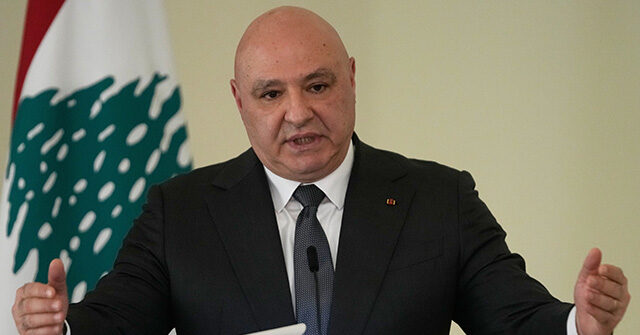
The foreign ministry of Lebanon announced on Tuesday it has withdrawn the accreditation of Iran’s ambassador, giving him five days to vacate the country.
Meanwhile, the Israeli military was digging in for a protracted battle against Iran’s terrorist proxy Hezbollah and mulling plans for the long-term occupation of southern Lebanon.
The Lebanese Foreign Ministry summoned Iran’s charge d’affaires on Tuesday to inform him of “the Lebanese state’s decision to withdraw approval of the accreditation of the appointed Iranian ambassador, Mohammad Reza Sheibani, and declare him persona non grata, demanding that he leave Lebanese territory no later than next Sunday.”
The ministry also recalled Lebanon’s ambassador to Iran, Ahmed Sweidan, for “consultations” over “Tehran’s violation of diplomatic norms and established practices.” This was evidently a reference to Iran’s Islamic Revolutionary Guard Corps (IRGC), a designated terrorist organization, boasting that it was coordinating with its Lebanese proxy Hezbollah to attack Israel.
Later on Tuesday, the Lebanese Foreign Ministry added that it was angry with the Iranian ambassador for “interference in Lebanon’s internal affairs” and “holding meetings with non-official Lebanese sides without going through the Ministry of Foreign Affairs.”
The Lebanese government outlawed all Hezbollah military activity on March 5 as an expression of Beirut’s mounting anger with the Iran-backed terrorists for unilaterally dragging Lebanon into a war with Israel, so any representative from Hezbollah or allied militias would now be considered “non-official.”
Israeli Foreign Minister Gideon Sa’ar applauded Lebanon for booting the Iranian ambassador as a “justified and necessary step toward the state responsible for violating Lebanon’s sovereignty, for its indirect occupation through Hezbollah, and for dragging it into war.”
“We call on the Lebanese government to take practical and meaningful measures against Hezbollah, whose representatives still serve as ministers within it,” he added, calling on Beirut to take further steps to purge Iran’s influence over Lebanese politics.
Hezbollah responded with a statement on Tuesday denouncing the expulsion of the Iranian ambassador as a “sin” and urging Beirut to “immediately reverse” its decision.
Tensions between Lebanon and Israel also increased on Tuesday, as the Israel Defense Forces (IDF) continued a ground offensive against Hezbollah that has displaced over a million civilians.
Israeli Defense Minister Israel Katz said on Tuesday that the IDF would create a “defensive buffer” by occupying southern Lebanon to “control the remaining bridges and the security zone up to the Litani.”
Katz said the occupation was necessary because the Lebanese government did not adequately respond to Israel’s warnings that it would lose territory if it failed to disarm Hezbollah, as required by the ceasefire agreement at the end of the Gaza War.
Katz added that residents of South Lebanon would not be able to return “until security is guaranteed for the residents of north Israel.”
Israel issued evacuation orders for the region south of the Litani River in early March to pave the way for heavy airstrikes and a ground invasion. Israel then launched airstrikes against five of the bridges over the Litani, seeking to shut down the routes Hezbollah was using to send elite fighters into southern Lebanon. Some humanitarian groups are worried that civilians who have not yet evacuated the conflict zone will be trapped if their escape routes across the Litanai are sealed off.
Hezbollah said on Tuesday that an Israeli occupation would pose an “existential threat to Lebanon as a state.”
Read the full article here