


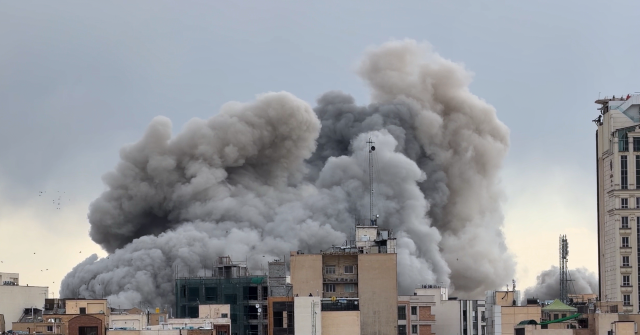
The Israel Defense Forces (IDF) announced a new wave of airstrikes against regime infrastructure in Tehran on Monday, even as President Donald Trump said “good and productive” talks with Iran could bring the conflict to an end soon.
The Israeli military said a “wide-scale wave of strikes” against Tehran began on Sunday night and were followed by a second round of strikes on Monday.
Al Jazeera News correspondents in Tehran reported detonations of “unprecedented” intensity on the eastern side of the Iranian capital while Iranian air defenses sought to repel American and Israeli drones.
“One person was killed after a radio station was targeted in Bandar Abbas. In Isfahan, Karaj, and Ahvaz, too, sounds of massive explosions were heard. In Ahvaz, we are hearing that one hospital was impacted as a result of the explosions,” an Al Jazeera reporter said, naming several other cities in Iran.
The IDF said on Friday that some of its strikes on regime infrastructure in Tehran have succeeded in destroying the fortified bunkers where Iranian leaders took shelter. An especially powerful blast dismantled the bunker once used by Supreme Leader Ayatollah Ali Khamenei, who was killed in the opening hours of the war.
On Monday afternoon, the Israeli Air Force said it was able to strike the “main security headquarters” of Iran’s Islamic Revolutionary Guard Corps (IRGC).
The IDF said the headquarters facility was embedded in “civilian infrastructure,” and was employed to “synchronize regional units responsible for enforcing regime order and internal security,” such as the infamous Basij repression militia.
“Prior to the strike, steps were taken to mitigate harm to civilians, including the use of precise munitions, aerial surveillance, and additional intelligence. The strike on the headquarters is part of the current operational phase aimed at further degrading core Iranian terror regime systems and security capabilities,” the IDF said.
Israel stepped up its bombing campaign after Iran managed to get ballistic missiles past the defenses of desert towns Arad and Dimona.
The missile strikes injured over 180 people and caused significant damage to residential buildings, shaking public confidence in Israel’s highly effective anti-missile defenses. The attack on Dimona was especially troubling because Israel’s main nuclear reactor is located there.
Even as Israeli strikes on Iranian targets escalated, President Trump said on Monday that American and Iranian representatives have been holding “very good and productive conversations regarding a complete and total resolution of our hostilities in the middle east.”
Trump said these talks have gone well enough to make him postpone “any and all military strikes against Iranian power plants and energy infrastructure for a five-day period.”
The president had previously set a 48-hour deadline on Saturday night for Iran to completely reopen the Strait of Hormuz to civilian traffic, or else the U.S. military would “obliterate” Iran’s power plants.
“We were planning tomorrow on shooting down some of their power plants,” Trump said on Monday during an appearance in Memphis, Tennessee. “Hopefully, we won’t have to do it.”
“I think there’s a very good chance we’re going to end up with a deal. We’re giving it five days and then we’re going to see where it takes us,” he said.
Iran on Monday seemingly backed down from its threat to mine the Strait of Hormuz, although it portrayed the decision as a product of Tehran’s confidence that it could control the strait and adjacent waterways without resorting to mines.
“The Islamic Republic of Iran has full and powerful control over the Persian Gulf region, the territorial waters of Oman and the Strait of Hormuz. Therefore, due to sufficient dominance and power, there will be no need for mine-laying in the Persian Gulf, and we will use every possible means to ensure security as necessary,” said Iranian military spokesman Ebrahim Zolfaghari.
Iranian state media quoted an unnamed source on Monday who said the Iranian military has “special plans” for “Tel Aviv and some regional allies of the U.S. and Israel, which will completely remove any hope of negotiation from the minds of the aggressors.”
Read the full article here