


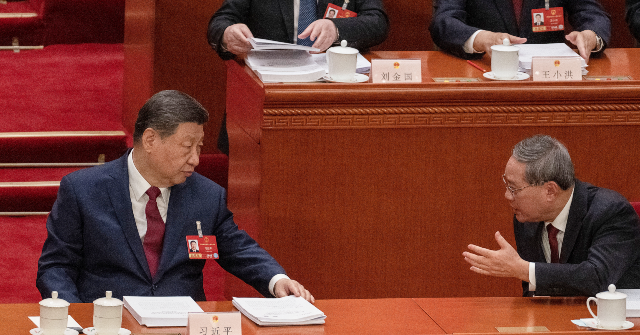
China’s big “Two Sessions” annual meeting of its rubber-stamp legislature produced a report on Friday that revised GDP growth projections down to a “range” of 4.5 percent to five percent, a significant downgrade from the 4.9 percent to five percent projection for 2025.
The revised growth target implicitly accepts the economic impact of the Iran war — and, in the eyes of many foreign analysts, is still far too optimistic about how well China can weather the loss of oil and gas from Iran and the Persian Gulf.
The “Two Sessions” are the simultaneous annual meeting of the National People’s Congress (NPC) and the Chinese People’s Political Consultative Congress (CPPCC) — which are, respectively, a theatrical “legislature” that exists to rubber-stamp the decrees of dictator Xi Jinping, and a powerless advisory body whose recommendations always coincide with whatever Xi was planning to do anyway. The 2026 sessions began on Tuesday.
The Two Sessions always include a great deal of discussion about China’s economy and this year it was already clear that spinning the bad news about faltering economic strength would be at the top of the agenda, even before the Iran oil shock hit. Some of the early statements from the CPPCC were copy-and-paste identical to the forced optimism it offered in 2025.
China’s state-run Global Times naturally labored to put the 2026 economic forecasts in the best possible light, portraying the revised 4.5 percent GDP projection as a worst-case scenario that China could probably overcome with enough “policy flexibility.”
Even the low-end projection was deemed sufficient by the Global Times to “lay a solid foundation for achieving the goal of doubling China’s 2020 per capita GDP by 2035 to reach the level of a moderately developed country.”
“The target of 4.5 percent to 5 percent economic growth for 2026, while striving to achieve better results in practice, is intended to strike a balance between what is needed and what is feasible,” chirped Shen Danyang, head of the group that produced the annual CPPCC work report.
Finance professor Tian Xuan of Peking University, who holds a seat on the NPC, reassured the Global Times that the reduced GDP estimate was about “recalibration” rather than “slowing down growth.”
“The modest downward adjustment is not a simple numerical change, but a pragmatic step grounded in economic reality and a move tailored precisely to long-term development goals,” Tian said.
The Global Times pumped out an editorial on Thursday that preemptively dismissed all foreign analysis of China’s reduced GDP projections as a scurrilous propaganda campaign:
Certain Western media outlets and individuals stubbornly insist that without real estate and low-end manufacturing, China’s economy would lose its driving force. Such thinking is like “looking at the sky from the bottom of a well,” ignoring the surge of innovation vitality now unfolding across China. Today, the guiding role of new quality productive forces is emerging with unprecedented momentum. From the global success of the “new three” industries — new-energy vehicles, lithium ion batteries, and photovoltaic products — to China’s ability to keep pace with and even lead in advanced fields such as 5G, artificial intelligence, and quantum computing, as well as pioneering exploration in the “uncharted frontiers” of science and technological innovation, such as future industries, and comprehensive breakthroughs have been achieved in core technology fields — from isolated points to the entire surface, and from the underlying layers to the terminals. This is by no means a simple industrial shift, but a profound transformation that is reshaping the very boundaries of productivity. It is driving a surging eruption of “ubiquitous growth drivers” like a gushing spring, building the hard-core confidence and unassailable foundation for China’s economy to hold a winning hand amid global geopolitical games — no matter how fierce the storms rage.
Nobody who writes a paragraph that long is trying to convince anyone but themselves.
Even before the Iran war, foreign analysts thought China’s projections were too optimistic. Goldman Sachs Research, for example, in January cited a consensus from international economists of 4.5 percent — the very same figure China now claims is the revised low-end prediction.
Goldman Sachs actually thought China could beat that estimate by 0.3 percent, in part because the “drag from a declining property market is expected to lessen,” and China’s trade dispute with the United States was beginning to stabilize, returning China’s trade surplus to 4.2 percent of GDP instead of the 3.6 percent in 2025.
The American Enterprise Institute (AEI) took a far dimmer view on Thursday, noting that China’s economy has been “generally weaker than acknowledged” since the Wuhan coronavirus pandemic, and the best medicine for its stagnant economy could be “reinflating the property bubble.”
That could be a tall order when there are still lingering fears the housing sector of the Chinese economy might collapse, or will never fully recover due to demographic shifts. To put it bluntly, a society in steep demographic decline does not produce a great deal of young couples looking to buy a home where they can raise their children.
The BBC on Thursday sensed anxiety on the sidelines of the Two Sessions as China “lowered its annual economic growth target to the lowest level since 1991.”
“China may have hoped to export its way out of economic trouble. But it has spent a year fighting a trade war with the United States, and now faces the prospect of upheaval in the Middle East, which supplies both its major shipping routes and a lot of its energy needs,” the BBC noted.
China needs the Strait of Hormuz open more than any other single buyer of Middle Eastern energy products, but the effects of losing that supply are difficult to calculate until the duration of Operation Epic Fury is known.
China would presumably be able to more easily absorb the losses from a conflict measured in weeks by tapping into its stockpiles of oil and relying on its prodigious domestic production, although the revised GDP estimates from the Two Sessions will probably need to be revised again.
The Atlantic Council on Thursday suggested China can actually weather the loss of liquid natural gas (LNG) from the conflict zone better than other Asian powers like Japan, South Korea, and Taiwan, so the net effect of a prolonged conflict could be to “empower Beijing relative to its regional rivals.”
Read the full article here