


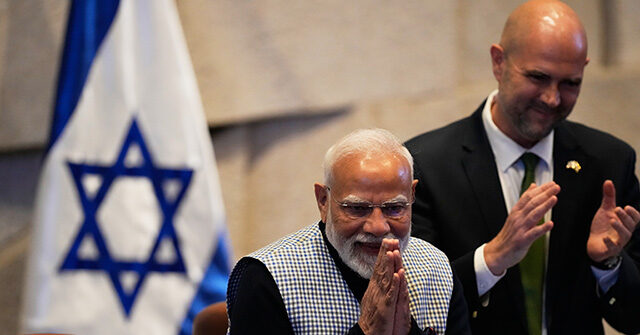
Indian Prime Minister Narendra Modi began a two-day visit to Israel on Wednesday in what both governments billed as an opportunity to build closer relations by making common cause against terrorism – and which some observers viewed as a ticking clock on potential American action against Iran, since a strike would not be likely until Modi leaves Israel.
Modi and Israeli Prime Minister Benjamin Netanyahu addressed the Knesset (the Israeli parliament) together on Wednesday and both spoke of dealing with deadly terrorist attacks. Israel, of course, suffered the Hamas atrocities of October 7, 2023, that launched the Gaza War, while India nearly went to war against Pakistan after terrorist gunmen murdered 26 people in the Kashmir resort of Pahalgam in April 2025.
Modi conveyed “the deepest condolences of the people of India for every life lost and for every family whose world was shattered in the barbaric terrorist attack by Hamas on October 7.”
“We feel your pain, we share your grief. India stands with Israel firmly with full conviction in this moment and beyond,” he told the Knesset on Wednesday.
“Like you, we have a consistent and uncompromising policy of zero tolerance for terrorism, with no double standards,” Modi said.
“Countering terrorism requires sustained and coordinated global action,” he said. “India supports all efforts that contribute to regional peace and stability.”
Modi described India and Israel as “ancient civilizations” whose partnership is “grounded in shared experience.” He praised Israel as a “powerhouse of innovation and technological leadership.”
Modi said he was delighted to see the practices of yoga and ayurveda, or Indian alternative medicine, spreading in Israel.
“I invite more and more young Israelis to travel to India. They will witness the dynamism of our society, and experience what holistic wellness can do for the body and the mind,” he said.
Netanyahu welcomed Modi to the Knesset as “a great friend of Israel, and a great leader on the world stage.”
“What we have done is doubled our trade. It’s been a wondrous friendship. The alliance between us is an enormous multiplier,” Netanyahu said.
“We are two democracies. We are now deepening our deep bond. Israel is stronger than ever, and India is stronger than ever,” he said.
Modi is the first Indian prime minister to address the Knesset and, after his speech, he became the first to receive the Speaker of the Knesset Medal, the highest honor bestowed by the Israeli parliament.
Modi also received the Grand Collar of the State of Palestine – the highest honor the nonexistent “state of Palestine” bestows upon foreign leaders – in 2018, putting him in a rather unique position.
Modi’s day at the Knesset was slightly darkened by an Israeli political controversy, as some opposition politicians boycotted the speeches from Netanyahu and Knesset Speaker Amir Ohana, to protest the lack of an invitation for Supreme Court President Isaac Amit to the event.
Amit was elected to the presidency of the court in January over the strenuous objections of Justice Minister Yariv Levin, who wanted a conservative instead of the liberal Amit, and spent the past 16 months blocking efforts to hold a vote that would have installed Amit. Amit was also hounded by allegations that he presided improperly over cases where he had a conflict of interest.
The Supreme Court finally broke the stalemate by forcing a vote, prompting Levin to declare Amit’s presidency illegitimate. A political brawl has raged ever since. The opposition staged a walkout during Netanyahu’s speech, but returned to hear Modi speak.
“We will only return for the Indian prime minister’s speech, to respect the alliance between the countries and express our appreciation for Prime Minister Modi’s standing by Israel,” said opposition leaders Yesh Atid and Yisrael Beytenu.
“The entire State of Israel is filled with admiration for your leadership, for your friendship, for the fact that you were here for us in our time of trouble, and for the alliance, the eternal alliance between our two states,” opposition leader Yair Lapid told Modi during his visit to the parliament.
Many observers noted that Modi’s visit to Israel came at a “delicate” time, as the U.S. masses forces to potentially strike Iran, and the Iranians are threatening to attack Israel in retaliation for any U.S. action. Whatever might be brewing in Iran seems to have been put on hold until Modi’s departure.
Read the full article here