


The Inflation Victory Lap Economists Said Trump Couldn’t Take
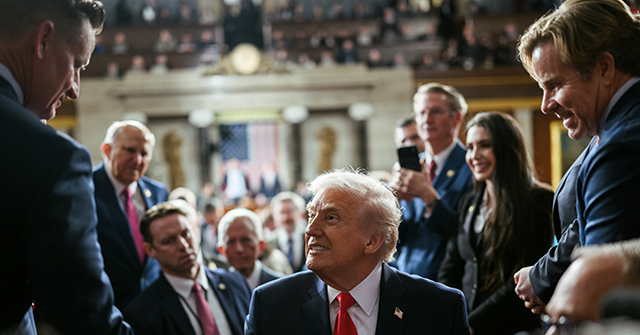
President Trump led off his State of the Union speech by addressing the state of the economy, highlighting the progress on bringing down inflation after the Biden-Powell surge that undermined America’s post-pandemic recovery.
“The Biden administration and its allies in Congress gave us the worst inflation in the history of our country, but in 12 months, my administration has driven core inflation down to the lowest level in more than five years, and in the last three months of 2025 it was down to 1.7 percent,” Trump said.
The math here is pretty simple. The three-month annualized rate of the consumer price index (CPI) excluding food and energy at the end of last year came in at 1.7 percent. The last time it was this low was the first quarter of 2021, the quarter that saw the transition from Trump’s first term to Joe Biden’s one-term presidency. A year prior, at the tail end of Biden’s administration, it was 3.1 percent.
If you take the average rate of inflation over the quarter, you get 2.2 percent. That compares with 3.4 percent at the end of 2024. Either way, it is true that inflation has come down a lot during the first year of Trump’s second term.
The Religious Conviction of Anti-Tariff Economists Meets Reality
This progress is all the more extraordinary because so many of the best and the brightest in the economics profession predicted that Trump’s policies would worsen inflation. Tariffs were going to drive up consumer prices. Trump’s immigration policies were going to cause a wage-price spiral that would send prices higher. Even Trump’s tax cuts were allegedly inflationary, according to some economists.
The critics of the president, of course, have not surrendered. But they are left pinning their attacks on Trump’s economic policies on questionable counterfactuals. Inflation would be even lower, they claim, if not for the tariffs, deportations, and tax cuts. But this is basically an unfalsifiable claim and not really worth considering. They would say that no matter what and no facts or economic evidence can dissuade them from the religious conviction that Trump’s trade and immigration policies are inflationary.
One of the weirder claims from the anti-tariff folks is that most of the “excess inflation” is coming from core goods—the stuff plausibly affected by tariffs—rather than services. But what the index tracking government calls “commodities less food and energy commodities” is up just 1.1 percent year-over-year through January. On a three-month annualized basis, it is up just 0.4 percent. That is about the average since the turn of the century and well-below the longer-term average for core goods of around two percent.
The January print for year-over-year core CPI was 2.5 percent. Since CPI tends to run about a half-point higher than the personal consumption expenditure price index the Federal Reserve uses for its official target, that means we have likely hit the target or come very close.
Underlying Inflation Is Very Low; 25% of Core Goods Prices Are Falling
The inflation hawks have pointed to the dispersion of inflation as a reason for caution. By Bank of America’s calculation, in December of 2025, 69 percent of core PCE and over 80 percent of core services had inflation above two percent. Back in 2019, only 57 percent of core PCE and 68 percent of core services were above target.
But median CPI tells a more reassuring story. It came in at an annualized 2.35 percent in January. That’s below its 10-year, 15-year, and 25-year averages. Even if we exclude the Bidenflation era, we’re still below the long-term averages. In other words, median CPI is telling us that underlying inflation is mild and below trend.
The Cleveland Fed’s measure of 16 percent trimmed mean CPI tells the same story. It hit an annualized 2.34 percent in January, also below the 10-year, 15-year, and 25-year averages even if you exclude the Bidenflation era.
When we ran through the January CPI report, we found that around 23 percent of CPI’s line items (excluding parent aggregates) declined in 2025. If we exclude services, it rises to 25.2 percent, meaning one-quarter of core goods fell in price year-over-year.
What’s more, real average weekly wages—meaning, after adjusting for inflation and changing workweek demands—rose 1.9 percent through January. That’s the highest rate of wage growth since March 2021. It is also twice the 10-year average, 2.4 times the 20-year average, and more than three times the 25-year average.
A golden age indeed.
Read the full article here