


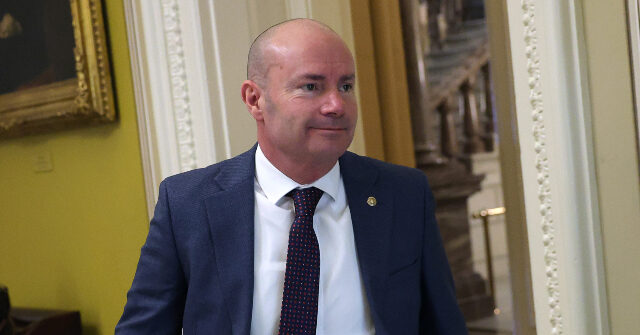
Sens. Mike Lee (R-UT) and Dick Durbin (D-IL) introduced legislation Monday that would protect Americans from warrantless government surveillance.
“The many documented abuses under FISA should provoke outrage from anyone who values the Fourth Amendment,” Lee said in a written statement.
He continued:
From warrantless searches targeting journalists, political commentators, and campaign donors to monitoring sitting members of Congress, these infringements reveal a blatant disregard for individual liberties. Our bipartisan reforms to FISA Section 702 are common sense and imperative to restoring trust in our government’s commitment to the Constitution.
Lee and Durbin proposed the Security and Freedom Enhancement (SAFE) Act, a bill that would reauthorize Section 702 of the Foreign Intelligence Surveillance Act (FISA) for two years, while providing safeguards to protect Americans’ civil liberties.
Section 702 is a surveillance authority meant to be used to spy on foreign adversaries; however, many Americans’ private communications incidentally get surveilled without a warrant, contrary to the Fourth Amendment protections against warrantless surveillance.
“Section 702 is a valuable tool to help keep our nation safe. However, it’s being used to conduct thousands of warrantless searches of Americans’ private communications. That’s unacceptable,” Durbin remarked. “Our bipartisan SAFE Act is a commonsense solution to continue protecting our country from foreign threats—while safeguarding Americans’ civil liberties and privacy.”
The bipartisan SAFE Act would:
- Require government agencies to obtain a FISA Title 1 order or a warrant before accessing the content of Americans’ communications collected under Section 702
- The bill would not require a warrant for searches of foreigners’ communications or searches to uncover connections between targeted foreigners and Americans.
- The requirement contains exceptions for “exigent” circumstances.
- Boost the role of the amici curiae who assist the FISA Court in evaluating the arguments presented by the Justice Department
- Close the “data broker loophole” that intelligence and law enforcement often use to purchase their way around the Fourth Amendment and privacy protections. Potential data that could be obtained skirting Fourth Amendment protections include location history.
- Fix the overly broad definition of the Electronic Communications Service Provider (ESCP), which subjects virtually any business, religious organization, nonprofit, etc. that uses email, voicemail, or other communications to forced government data collection under FISA. This definition was expanded during the last FISA reauthorization fight.
- Close the Section 215 loophole that allowed the federal government to continue using surveillance authority which expired in 2020.
James Czerniawski, the head of emerging technology policy at the Consumer Choice Center, told Breitbart News in a statement that Lee and Durbin’s SAFE Act would balance the need to protect Americans’ privacy while ensuring national security.
“For too long, Section 702 has been treated as a blank check for government overreach, turning a foreign intelligence tool into a domestic surveillance dragnet. The SAFE Act finally draws a line in the sand, delivering the oversight Americans deserve without compromising the security we require to keep the country safe,” he said in a written statement.
“We applaud Senators Lee and Durbin for their tireless leadership in crafting a solution to this critical issue. They understand correctly that we don’t have to sacrifice our liberty for our safety, and we stand ready to work alongside them to get this across the finish line,” he added.
Groups on the left have also cheered Lee and Durbin’s efforts to find a bipartisan solution to government surveillance.
“Right now, the government can freely troll through your private emails and texts swept up in 702 collections and this power has been abused to spy on everyday Americans, journalists and even members of Congress,” Demand Progress senior policy advisor Hajar Hammado said in a statement.
“No government, whether it’s run by Donald Trump and Stephen Miller or Joe Biden, should be able to do this. The SAFE Act is a bipartisan solution to this problem and all members of Congress should not support reauthorization without these critical reforms,” Hammado continued. “We thank Sens. Lee and Durbin for their leadership on this bill and for modeling how Republicans and Democrats can come together to stop oppressive government overreach.”
One Politico report claimed that White House officials favor a “clean” extension of Section 702; however, doing so would serve as a major headache for Speaker Mike Johnson (R-LA), who frustrated conservative lawmakers when he sided with Intelligence Committee members and cast the deciding vote against requiring a warrant to obtain Americans’ private communications.
House Intelligence Committee Chairman Rick Crawford (R-AR) and House Judiciary Committee Chairman Jim Jordan (R-OH) are still in talks about a potential compromise effort that would put more guardrails on Section 702.
“We know 702 is important,” Jordan said. “We know it needs to get reauthorized. We’re committed to getting that done. We just want to do it in the best way possible so that you can get the bad guys, know what the bad guys are doing overseas, but also protect Americans, and I’m confident we’ll get there.”
During a hearing in mid-February, Attorney General Pam Bondi told Rep. Andy Biggs (R-AZ) that the Trump administration is committed to working with Congress to end warrantless surveillance of Americans.
Biggs said:
In January 2025, you testified before the U.S. Senate and agreed with Sen. Lee that “Any time an American’s private communications are intercepted or stored, whether through incidental collection or otherwise, those communications should not be searched without some showing of probable cause.”
Bondi responded, “We are committed to working with you on that. And we are working with Chairman Jordan, the House Intel, with all of my fellow cabinet members on resolving that issue.”
Read the full article here