


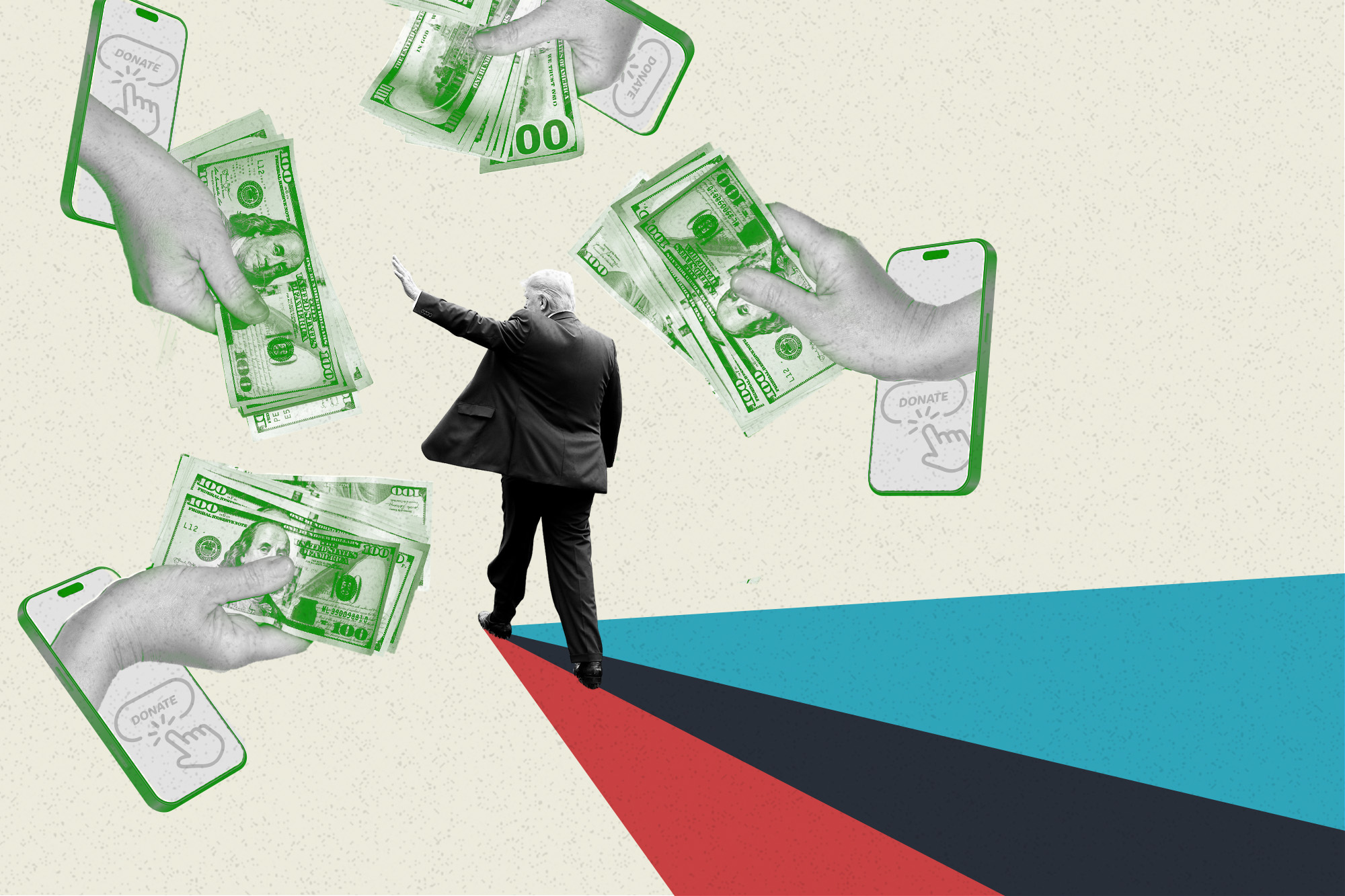
Donald Trump still raises far more money online than any other GOP figure.
Democrats get major fundraising boosts when they clash with him.
And the Democratic money machine continues to churn — a sign of hope for a party seeking to regroup from brutal losses the year prior.
Those are among the key patterns that appeared in a POLITICO analysis of online fundraising across 2025, as both parties began to gear up for highly competitive midterms.
The sweeping POLITICO analysis of data from ActBlue and WinRed — the primary fundraising platforms for each party — revealed how Trump, who is constitutionally barred from seeking reelection, is still at the center of the GOP’s digital and financial universe. And while Democrats continue to debate how much they should focus on opposing Trump in their broader campaign messaging, the data shows just how strongly the GOP president motivates liberal donors.
Major surges in online Democratic fundraising were fueled by members of the party standing up to — or being attacked by — the president. Democratic candidates’ biggest fundraising days on ActBlue were all driven by conflict with Trump, with those days accounting for millions of dollars raised from tens of thousands of donors giving online for the first time this cycle.
Among Republicans, Trump’s own joint fundraising committee, Trump National Committee, continued to raise the most money out of anyone on WinRed in 2025, bringing more over the course of the year than the next two biggest GOP groups combined. Trump’s political operation accounted for more than 1 in 5 total dollars raised federally through WinRed last year.
ActBlue and WinRed report all donations made to federal campaigns and committees through their platforms, providing a detailed picture of small-dollar giving. The platforms are so dominant that they include the vast majority, though not all, of online donations for both parties.
The data provides insight not only into who raised the most but the specific moments that drove donors to give.
Leading the way was Sen. Cory Booker (D-N.J.), who saw a massive surge in donations when he broke records with a 25-hour quasi-filibuster speech protesting the Trump administration’s policies.
Booker’s campaign committee received nearly 92,000 donations totaling $2.5 million on ActBlue on April 2, the day after his speech finished. It was the highest single-day total for any federal committee on the platform in 2025. For roughly a third of those donors, it was their first donation of the year on ActBlue.
The New Jersey senator was not the only Democrat to get a donation boost off of standing up to Trump. California Gov. Gavin Newsom’s joint fundraising committee saw a massive surge in donations in early June after he sued the Trump administration to block the deployment of the National Guard to Los Angeles and Trump suggested arresting the governor. The group, Campaign for Democracy, recorded more than 47,000 donations on June 11, for a total of $1.3 million.
That was the start of a three-day surge that accounted for nearly one-third of all online donations to the Newsom joint fundraising committee in 2025.
Sen. Mark Kelly (D-Ariz.) saw nearly 43,000 donations for a total of nearly $1.3 million to his campaign committee Nov. 25 after Defense Secretary Pete Hegseth ordered the Pentagon to investigate whether a video that featured Kelly and others advising troops not to follow illegal orders was itself unlawful. Roughly 1 in 5 donations on the platform that day went to Kelly’s campaign.
Kelly then remained the top fundraiser nearly every day for three weeks after that, bringing in donations from about 278,000 unique donors in November and December. That surge set Kelly apart from other Democratic figures last year for both its intensity and duration. The POLITICO analysis found that more than three-quarters of donors in that time period had not given to Kelly previously in the year. For 1 in 5 of his donors, it was the first time they’d given to any Democrat through ActBlue in the entire year.
Kelly’s strong preexisting brand helped him leverage the attack from Trump into a fundraising bonanza, said Mike Nellis, a democratic digital strategist and founder of the firm Authentic.
“You can raise a ton of money by just opposing Trump,” Nellis said. “But if you want to elevate yourself into that stratosphere of becoming a household name that people believe in, with Democratic donors who are going to give you $5, $10, $25, over and over and over, you’ve got to go a little bit deeper.”
Democrats’ dream of flipping the Senate also fueled massive contributions. A handful of Senate candidates — Roy Cooper in North Carolina, Sherrod Brown in Ohio, Janet Mills in Maine and both James Talarico and Jasmine Crockett in Texas — were the top Democratic online fundraisers when they launched their respective campaigns.
Sen. Jon Ossoff (D-Ga.), the only incumbent Democratic senator seeking reelection in a state Trump won in 2024, brought in $32.5 million through ActBlue in 2025, more than any other candidate on the platform. Democrats running in competitive Senate races this year were consistently among the top overall fundraisers on ActBlue, as was the Democratic Senatorial Campaign Committee itself.
The online fundraising landscape for Democrats looking to take back the House was more muddled, with the top fundraising numbers coming more often from progressive stars than candidates in competitive races.
Rep. Alexandria Ocasio-Cortez (D-N.Y.), long a fundraising powerhouse, raised $22.8 million on ActBlue in 2025, the most of any House Democrat, followed by House Minority Leader Hakeem Jeffries, who raised just shy of $11 million through his campaign and joint fundraising committee, then Rep. Eugene Vindman (D-Va.) and Eileen Laubacher, one of the Democrats seeking to challenge Rep. Lauren Boebert (R-Colo.) in a heavily Republican district.
Those House candidates reflect a few of the different ways that virality can help online fundraising. More than 400,000 donors gave to Ocasio-Cortez’s campaign more than once in 2025, reflecting her strength with returning donors. Laubacher’s numbers reflect how running in a district represented by a high-profile Republican can attract Democratic donors — even as she still has to get through a primary to face Boebert.
But vulnerable Democratic House incumbents and candidates running in some of the most competitive battlegrounds were not represented among those with the best online fundraising numbers — a challenge for party strategists as they fight for the resources to flip the House.
“The things that work to raise money from small donors are the opposite of the things that work to beat MAGA,” said Liam Kerr, co-founder of the centrist Democratic group WelcomePAC.
At the same time, Kerr said that there was enough variety in the candidates who put up strong online fundraising numbers to suggest that more moderate candidates can make inroads.
Donors give, Kerr said, because they want to “feel like they’re part of something.” If candidates in key races can start to capture the attention of donors across the country, then, he said, “the base of the raged donor class would start to shift to what they thought could beat Trump.”
Methodology: Donations and monetary totals are based on ActBlue and WinRed receipts, not reports from campaigns. Donations that were later refunded are still included in the totals.
Read the full article here