


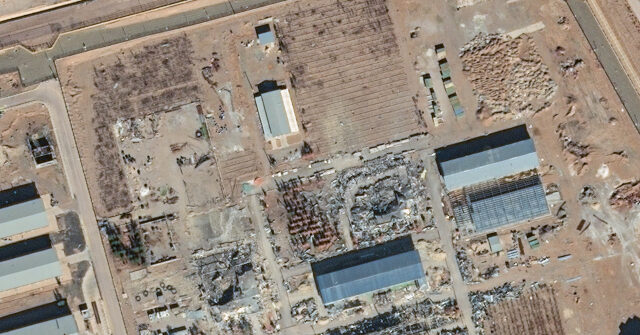
New satellite imagery shows Iran has buried the entrances to a hardened tunnel complex at its Isfahan nuclear site — a move a U.S.-based watchdog said signals Tehran is “seriously concerned” about a U.S. or Israeli strike or raid.
High-resolution imagery taken Monday shows the extent to which Iran has covered the tunnel entrances at the Isfahan nuclear complex with soil, the Institute for Science and International Security reported, saying the middle and southern entrances are now “unrecognizable and fully covered” and the northernmost entrance has also been backfilled.
The institute said no vehicle activity is visible around the three entrances, indicating access points have been blocked and the work appears complete.
“It appears clear that the Iranians are seriously concerned about a US/Israeli aerial attack and/or raid against this particularly hardened nuclear facility,” the institute assessed, arguing the backfilling would help dampen any potential airstrike and make ground access in a special forces raid — aimed at seizing or destroying highly enriched uranium — far more difficult.
The institute added it is also possible Iran moved equipment or material into the tunnels for protection, though it said that cannot be confirmed from imagery alone, noting that similar preparations were observed in the days before Operation Midnight Hammer struck Fordow, Natanz, and Esfahan last June.
The Jerusalem Post, citing experts reviewing the imagery, cast the activity as part of a broader defensive push around the Islamic Republic’s most sensitive nuclear and missile infrastructure.
Jonathan Hackett, a former U.S. Marine Corps veteran who served 20 years in counterintelligence with attachments to U.S. intelligence agencies and special operations units, told the Post that late-January and early-February activity around the Isfahan complex likely reflects “a larger push to create defensive layers” in anticipation of a possible U.S. strike.
Hackett said that while engineering units were backfilling the tunnels in Isfahan, the IRGC was also “surging to protect ballistic missile sites,” describing it as part of the regime’s “Mosaic Doctrine,” in which IRGC ground and aerospace forces work to secure the physical infrastructure used to transport, store, and protect missiles for retaliation.
Dr. Lynette Nusbacher, a former British Army intelligence officer, told the Post Iran is protecting facilities “in ways that are observable from satellites,” adding it is “certainly easier” to clear tunnel entrances with bulldozers than to rebuild after a Tomahawk strike or a Massive Ordnance Penetrator turns sites into craters.
The new fortification steps follow earlier satellite reporting suggesting Tehran has been trying to obscure what survived last year’s strikes and what it may be recovering.
In late January, the Associated Press reported Planet Labs imagery showed new roofs built over damaged buildings at Isfahan and Natanz — the first major visible activity at those bombed nuclear sites since the June war — blocking satellites from seeing ground work as Iran has prevented International Atomic Energy Agency inspectors from accessing the sites.
The AP report quoted analysts who argued the coverings likely signaled an effort to recover assets without outside observers seeing what, if anything, was removed, while also noting additional fortification activity around tunnel entrances near Isfahan.
A New York Times analysis of satellite imagery similarly described an uneven reconstruction pace — faster repairs at missile facilities, slower and more opaque activity at nuclear sites — and quoted Institute president David Albright assessing that piling dirt at Isfahan may be in “anticipation of an attack,” implying there is “something in there that’s valuable,” potentially enriched uranium.
The latest imagery lands as Washington has signaled heightened maritime concern in the Persian Gulf.
In a notice issued Monday, the U.S. Maritime Administration advised U.S.-flagged ships transiting the Strait of Hormuz to remain “as far as possible” from Iranian waters and to decline permission for Iranian forces to board, warning that boarding attempts — including efforts to force commercial vessels into Iranian waters using small boats and helicopters — have occurred as recently as last week.
The advisory instructed that if Iranian forces attempt to board, masters should decline permission if it would not compromise safety, and if boarding occurs anyway, crews should not forcibly resist — while stressing non-resistance does not imply consent.
Other reporting on the Gulf flare-ups noted the broader atmosphere: Iran has threatened violence against Americans in the waterway, and last week tensions escalated after the United States shot down an Iranian drone headed toward the USS Abraham Lincoln and a U.S.-flagged ship outran an effort by armed Iranian gunboats to halt it.
The Hormuz guidance came as indirect U.S.-Iran nuclear talks resumed in Oman on Friday — described by Iran’s president as “a step forward,” and by Foreign Minister Abbas Araghchi as “a good start” — with President Donald Trump calling the talks “very good” while warning failure to reach a deal would bring “very steep” consequences for Tehran.
Satellite-based reporting from Reuters on Tuesday also underscored the broader regional posture, describing U.S. equipment and aircraft movements across key bases — including Patriots positioned on mobile launchers at Al-Udeid in Qatar — as tensions rose.
Tehran paired the diplomatic track with fresh threats on Tuesday as well.
Iranian Army chief Major General Amir Hatami warned that any enemy “miscalculation” would be met with an “unprecedented” response, arguing the regime’s defense and diplomacy operate as one field against hostile pressure.
The escalation backdrop now converges at the White House, where Israeli Prime Minister Benjamin Netanyahu is set to meet President Trump on Wednesday as Israel presses for any U.S.-Iran framework to address not only the nuclear program, but also Tehran’s missile program and proxy networks.
Trump has also publicly warned that if negotiations fail, Washington may take tougher action — a posture that helps explain why Tehran appears to be racing to harden access to what may remain inside its most sensitive underground sites.
Joshua Klein is a reporter for Breitbart News. Email him at [email protected]. Follow him on Twitter @JoshuaKlein.
Read the full article here