


Warsh War III: The Fight Against Groupthink
Editor’s Note: This is the final installment in a three-part series examining Kevin Warsh’s nomination to chair the Federal Reserve. Read Part I here and Part II here.
In March 2016, Kevin Warsh stood before the National Association for Business Economics and delivered what may be the most blistering critique of Federal Reserve decision-making ever offered by a former Fed governor. The speech, titled “Challenging the Groupthink of the Guild,” laid out a comprehensive indictment of how the Fed conducts monetary policy.
“The clustering of economic forecasts reveals conformity of views inside the Fed,” Warsh argued. He noted that estimates among Federal Open Market Committee (FOMC) participants were “very closely aligned” and “closely match the outputs of the staff forecast.” This wasn’t just an academic concern. The Fed’s internal groupthink was “deepening the groupthink among other stakeholders, including outside economists, Wall Street pros, and business leaders.”
Five years later, the Fed’s catastrophic miss on inflation vindicated Warsh’s diagnosis. An institution more open to challenging the transitory inflation narrative would have tightened sooner. An institution less obsessed with achieving consensus and more open to internal dissent would likely have been better prepared to navigate our post-pandemic economy.
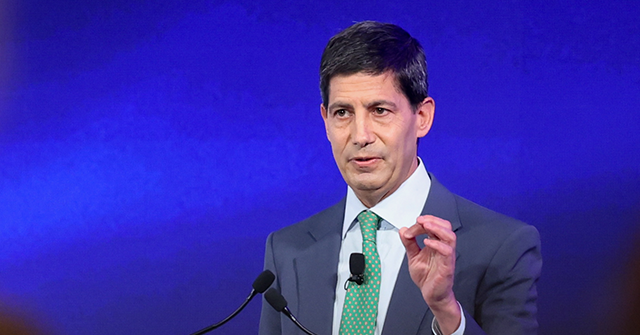
Former Federal Reserve Governor Kevin Warsh speaks at the International Monetary Fund (IMF) and World Bank Spring meetings in Washington, DC, on April 25, 2025. (Tierney L. Cross/Bloomberg via Getty Images)
The Model Worship Problem
Warsh’s most fundamental critique targets the Fed’s devotion to economic models that consistently fail to predict reality. He uses a provocative historical analogy: the Fed’s attachment to its models resembles the centuries-long adherence to Ptolemaic astronomy, which placed the Earth at the center of the universe despite mounting contrary evidence.
“When the real economy fails to comport with their heralded model-based forecasts, they judge that the error invariably belongs to the real world,” Warsh observed. The Fed explains away persistent forecast failures as “headwinds” – temporary factors that will soon dissipate. But “seven years of headwinds suggests a problem not with the weather, but the climate.”
The dominant models employed at the Fed and establishment macroeconomists are, in Warsh’s assessment, “at best, a way station between Ptolemy than Copernicus.” They systematically underestimate the importance of global economic developments, largely ignore the financial sector despite the 2008 crisis, and assume markets are efficiently priced, at least when prices are rising.
The problem isn’t that models are useless. “All economic models are wrong, some are useful,” Warsh acknowledges. The problem is treating model outputs as gospel rather than as rough guides that should be heavily supplemented with judgment and market signals.
The “Data Dependence” Trap
Perhaps no phrase is more sacred in modern Fed communications than “data dependent.” Warsh calls it potentially “the most dangerous words in the conduct of monetary policy.”
Why? Because what counts as “data” for Fed purposes is “anachronistic, backward-looking, and subject to massive revisions.” The monthly employment report that moves markets has standard error bounds “about equal to the net estimate.” The February 2016 report showed 242,000 jobs created, but that estimate was “statistically significant… plus or minus 100,000.”
Moreover, policy affects the economy “with long, variable and uncertain lags.” As a wise central banker once told Warsh: “Policymakers must move early because they are late.”
Instead of obsessing over backward-looking official statistics, Warsh argues that the Fed should pay more attention to market prices, which offer “contemporaneous insight into the real economy.” In particular, watching the prices of commodities—especially metals—would improve the performance of monetary policy. The Fed should “focus our countercyclical policies on the left side of the decimal point, not the right side.” That is, the Fed should be responding to large, persistent changes in economic activity, not “fiddling with measures of the NAIRU” to explain away inconsistent data.
The Forecasting Fiction
Warsh saves special scorn for the Fed’s proliferation of forecasts. In 2015, FOMC members provided “more than 70 individual point estimate forecasts” and gave “about 62 formal ‘economic outlook’ speeches. That was double the number from a decade earlier.”
“To what end, exactly, this proliferation of forecasts?” Warsh asks. “The Fed has not forecasted a US recession accurately 12 months before its arrival since WWII.”
Paul Samuelson famously quipped that “Wall Street indexes predicted 9 of the last 5 recessions.” Warsh’s retort: “That is better than 0 for 12, the Fed’s post-war batting average.”
The forecasting obsession carries massive opportunity costs, Warsh contends. “The economic brain trust at the Fed is a precious public resource. It ought not to be squandered by repeating outputs of broken models.” That talent should be “aimed squarely at the toughest, most consequential economic issues of our time.”
From Critic to Chairman
Warsh’s critique connects to his broader concern about Fed mission creep. The central bank kept promising its extraordinary policies would deliver broad prosperity but that never happened. The Fed’s QE worked through a “wealth effect” — and “the wealth effect works best for the wealthy.” While household wealth increased impressively “for those who already possessed financial assets,” Warsh noted that “about half of American households have no accumulated balance sheet wealth.” QE was a non-entity for most Americans whose purchasing power and wealth is less exposed to the flood of liquidity it created.
It’s tempting to think of Warsh’s nomination as a puzzle: Trump wanted a dove but picked a hawk, as some have said. But this assumes the only thing that matters is where rates go. Warsh has consistently argued for looking at market signals and real-time information, engaging in robust internal debate, and avoiding forward guidance that locks the Fed into a path. That framework is compatible with a range of rate decisions.
And lately he has signaled that he thinks the central bank should look past any tariff-induced price hikes (which should be easy enough, since they have ranged from non-existent to insignificant) and that improved productivity can raise output growth without raising inflation, precisely the rejection of Phillips Curve thinking he articulated in 2016.
The real question isn’t whether Warsh is a hawk or dove. It’s whether his analytical approach will improve Fed decision-making. The establishment types endorsing Warsh and the populists who are concerned are both likely to be surprised by Chairman Warsh’s policies.
Read the full article here