


Warsh War II: Is There a Way Out of QE World?
Editor’s Note: This is the second in a three-part series examining Kevin Warsh’s nomination to chair the Federal Reserve. Read Part I here.
The most consequential feature of Kevin Warsh’s view of the Federal Reserve is his focus on balance sheet reduction.
Throughout his post-Fed commentary, he’s warned about what he calls “economic imprinting,” markets coming to expect central bank support at any sign of trouble. He supported emergency QE during crises but consistently argued it shouldn’t become permanent. In a June 2021 op-ed, he criticized the Fed’s “risky fill-the-punch-bowl strategy,” warning that “by that point the emergency justification for QE had passed, and keeping monetary conditions ultra-loose risked asset bubbles and future instability.”
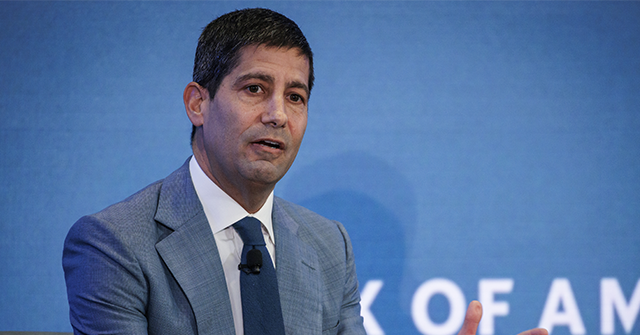
Former Federal Reserve Governor Kevin Warsh speaks during The Semafor World Economy Summit in Washington, DC, on April 18, 2024. (Samuel Corum/Bloomberg via Getty Images)
Warsh’s critique lays bare something that has gone almost unnoticed. While QE and the buildup of the Fed’s now enormous balance sheet began as an emergency response to the events of 2008, with the Fed scrambling to find a way to make monetary policy even more accommodative despite lowering its interest rate target to zero, it somehow metastasized into the standard operating procedure for central banking. Without any real public deliberation and no legislation that might have lent the transformation democratic legitimacy, the Fed moved our financial system from one of scarce reserves to one of what it calls ample reserves.
Bringing Banking Out of the Shadowy World of ‘Ample Reserves’
Most Americans have no idea how big of a paradigm shift this has been. The details are shrouded from the common citizenry. How many Americans are aware that the Fed no longer even imposes reserve requirements because the system is so awash in reserves that mandatory levels are redundant? Even many financial professionals still think the Fed requires banks to hold reserves.
Here’s how the Fed explained the shift back in 2020:
“For many years, reserve requirements played a central role in the implementation of monetary policy by creating a stable demand for reserves. In January 2019, the FOMC announced its intention to implement monetary policy in an ample reserves regime. Reserve requirements do not play a significant role in this operating framework.
In light of the shift to an ample reserves regime, the Board has reduced reserve requirement ratios to zero percent effective on March 26, the beginning of the next reserve maintenance period. This action eliminates reserve requirements for thousands of depository institutions and will help to support lending to households and businesses.”
It’s not just the reserve requirement that is gone. So, is the effectiveness of the Fed’s main policy benchmark, the federal funds rate. Although the Fed still announces a federal funds target, the real lever in monetary policy is now interest paid on reserves. The entire financial system has become a sort of shadow banking system, where the actual operations bear only a shadow’s resemblance to the historical version that much of the public still thinks is operational.
Warsh has been thinking about this longer and more carefully than almost anyone. In a 2017 speech, he noted that the Fed’s “normalization strategy” of combining slow rate hikes with a very gradual balance-sheet runoff “differ[ed] markedly from what was agreed when we conceived QE in the ‘war room’ amid the crisis.” He called for clearer communication and a more strategic exit that would minimize market disruption while making clear the Fed wouldn’t support markets indefinitely.
Jerome Powell’s cautionary 2018 experience—when his “auto-pilot” balance sheet reduction triggered a selloff and forced a pivot—shows the challenge. But it doesn’t invalidate the goal. If anything, it demonstrates how entrenched market dependence on Fed liquidity has become, which is exactly what Warsh has been warning about. Working with Treasury Secretary Scott Bessent on what observers are calling a coordinated monetary-fiscal approach, Warsh may finally have the opportunity to execute the strategic balance sheet reduction he’s long advocated. Getting this right would be his most important achievement.
Critics often assume that shrinking the Fed’s balance sheet must tighten financial conditions, but Warsh doesn’t see it that way. His argument is more nuanced: if markets are reassured that monetary policy will remain accommodative when appropriate—and that balance sheet normalization is part of a long-term strategy, not a sudden shock—the process need not trigger another “taper tantrum.” In fact, restoring a more market-driven financial system could improve price discovery and investment allocation, supporting sustainable growth without excess liquidity dependence.
The stakes are high. If Warsh succeeds in shrinking the balance sheet and weaning markets off Fed support, he’ll have restored something closer to normal monetary policy and market function. If he fails—or if the attempt triggers another crisis—it will validate critics who say QE has created a trap that the Fed can never escape.
Tomorrow: How Warsh plans to reform the Fed’s internal decision-making and governance.
Read the full article here