


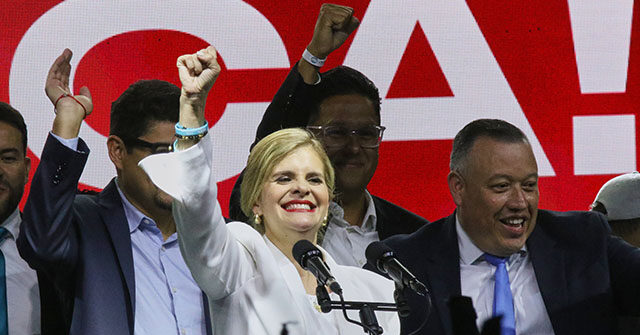
Costa Rica’s 39-year-old conservative politician, Laura Fernández, became president-elect of the Central American nation on Sunday, winning a 15-point lead ahead of her closest rival in the first round of the election.
Fernández vowed to carry out a “Bukele-style” crackdown on crime and drug trafficking on her country. The new president-elect, who is widely described as the “political heir” to outgoing President Rodrigo Chaves, will take office as the next president of Costa Rica for a four-year term on May 8.
Millions of Costa Rican voters headed to the polls on Sunday to elect their new president and all 57 members of its Legislative Assembly. Although Sunday’s first round of Costa Rica’s 2026 presidential election saw the participation of 20 different candidates in the ballot, the race was primarily led by Fernández, representing the conservative Sovereign People’s Party (PPSO), and economist Álvaro Ramos of the Center-left National Liberation Party (PLN).
The latest preliminary results published by the Supreme Electoral Court of Costa Rica (TSE) at press time indicate that, Fernández obtained 48.33 percent of the votes against Ramos’s 33.42 percent. Article 138 of Costa Rica’s constitution establishes that a president must obtain over 40 percent of the vote to win in the first round. Had no candidate obtained the required amount of votes to win in Sunday’s first round, TSE had scheduled a prospective runoff election for April 5. Voter turnout was measured at 69.10 percent.
In addition to winning the presidency, the conservative PPSO party also obtained 31 of the 57 seats at the Legislative Assembly, reportedly granting the Costa Rican conservatives its largest majority at the parliament since 1982. The majority will grant the PPSO enough votes to carry out reforms that require a simple majority in parliament, but it is seven votes short from the qualified majority required for constitutional reforms, tax increases, and other similar reforms.
Fernández served as both planning minister and minister of the presidency under the administration of Rodrigo Chaves. Among her top campaign promises, the new president-elect vowed to enact what she described as the “Third Republic,” a series of reforms to tackle state corruption and inefficiency as well as restore trust in the judiciary. She also vowed to enact a fierce crackdown on crime and drug-related violence similar to the one enacted by Salvadoran President Nayib Bukele in his country in response to Costa Ricas’s growing gang violence problem. Fernández’s plans for finalizing construction of a new maximum security prison similar to El Salvador’s CECOT.
Speaking to her followers on Sunday after her victory, Fernández said that he will “preside over a government of dialogue and national harmony, respectful and firm in its adherence to the rule of law” while criticizing the opposition as “obstructionist and sabotaging.”
“Democracy is, above all, the rule of law, where the will of the majority prevails and is obeyed, but where the feelings of minorities are equally respected and protected,” Fernández said, and emphasized that “understanding it differently exposes us to the arbitrariness and authoritarianism that no one wants and that I, as the new president of the Republic, will never allow.”
The conservative president-elect reportedly made statements in favor of life, family, and the free market, and expressed her gratitude to outgoing President Chaves, who supported her now successful 2026-2030 presidential bid. Fernández also vowed that her administration would carry out four more years of conservative continuity in Costa Rica, as outgoing President Chaves is term-limited and cannot run for reelection again until at least two terms have passed.
“I have just congratulated Costa Rica’s President-elect, Laura Fernández, by telephone,” President Nayib Bukele wrote on social media. “I wish her every success in her government and all the best for the beloved people of Costa Rica.”
Other regional heads of state, such as Chile’s conservative President-elect José Antonio Kast, Panama’s José Raúl Mulino, and Paraguayan President Santiago Peña have publicly congratulated Fernández for her victory.
Christian K. Caruzo is a Venezuelan writer and documents life under socialism. You can follow him on Twitter here.
Read the full article here