


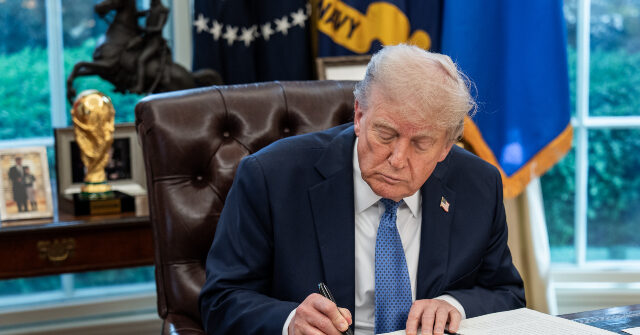
President Donald Trump signed an executive order Thursday declaring a national emergency over the threats to America posed by Cuba, a state sponsor of terrorism.
President Trump, as part of his maximum pressure campaign on Cuba’s Communist Castro regime and to counter its malign influence, established a process to impose tariffs on any country providing oil to Cuba — which the rogue communists desperately need to keep the nation’s barely-functional infrastructure working.
“The President is addressing the depredations of the communist Cuban regime by taking decisive action to hold the Cuban regime accountable for its support of hostile actors, terrorism, and regional instability that endanger American security and foreign policy,” the order reads.
For over six decades, the Castro regime has turned Cuba into a key supporter of dangerous terrorist organizations such as Hamas, Hezbollah, and Colombia’s FARC and ELN Marxist terrorist guerrillas. In 1982, the United States included Cuba on its list of State Sponsors of Terrorism (SST) in response to the country’s lengthy track record of supporting international terror. In addition to Cuba, the SST list includes Iran, Syria, and North Korea.
Since then, Cuba has only been off the SST list on some limited occasions: first, in 2015 during the administration of former President Barack Obama, who had Cuba removed from the list as part of the “Cuban Thaw,” a series of policies that saw the Castro regime receive an extensive amount of concessions courtesy of the Obama administration.
President Trump had Cuba reintroduced to the list in the last days of his first term in January 2021. Former President Joe Biden sought to have Cuba removed from the list again during his last days in office in January 2025. President Trump revoked that executive action alongside several others in the first hours of his second term.
In addition to sponsoring international terrorism, the Cuban regime has supported and receives support from some of the world’s most notorious anti-U.S. regimes, such as Russia, Iran, and Venezuela. In the case of Venezuela, its socialist regime provided the Castro regime with constant supplies of oil in exchange for ideological, logistical, and other forms of support to help establish and reinforce its own authoritarian regime at home, such as allowing Cuban military presence in Venezuela and providing protection to Nicolás Maduro, who did not trust Venezuelans with his own security.
President Trump included Cuba’s alliances with international terrorist and anti-U.S. regimes as among the Castro regime’s actions that constitute a threat to U.S. national security and foreign policy and require immediate response.
Additionally, President Trump detailed Cuba’s extensive track record of persecution and torture of political dissidents, lack of free speech and press, corruption, and the chaos derived from the Castro regime spreading communism in the region as other threats to U.S. national security.
The executive order allows the U.S. to impose additional tariffs on any country that “directly or indirectly” provides oil to Cuba. President Trump may modify the order if Cuba or any affected country takes significant steps to address the threats to United States national security.
“President Trump has consistently confronted regimes that threaten U.S. security and interests, delivering where others have failed to hold adversaries accountable,” The White House stressed.
As a result of the United States capturing Maduro and taking control of Venezuela’s oil exports, the Castro regime has been cut off from accessing Venezuelan oil. President Donald Trump has explicitly stated over the past days that U.S. foreign policy would soon target Cuba.
“THERE WILL BE NO MORE OIL OR MONEY GOING TO CUBA — ZERO! I strongly suggest they make a deal, BEFORE IT IS TOO LATE,” Trump wrote in a Truth Social post on January 11.
This week, the leftist government of Mexico confirmed that the state-owned oil company Pemex cancelled an oil shipment to Cuba originally scheduled to arrive in the island nation toward the end of January. Although President Claudia Sheinbaum acknowledged that the shipment had been cancelled, she neither confirmed nor denied whether the measure meant that Mexico would no longer supply oil to Cuba. Mexico has supplied the Castro regime with oil since 2023 and became Cuba’s top supplier when Venezuela stopped providing the ruling communists with oil.
The White House said:
This is not the first time President Trump has taken a tough stance against hostile regimes — in just the past few months, he has ordered strikes on Iran’s nuclear infrastructure and authorized operations to remove Venezuela’s Nicolas Maduro from power, making clear that dictators and state sponsors of terrorism will be held to account.
The Castro regime’s figurehead “president,” Miguel Díaz-Canel, condemned President Trump’s executive order in a three-post social media message on Friday, accusing Trump of seeking to “stifle the Cuban economy” by imposing tariffs on countries supplying oil to Cuba under a “false pretext and empty arguments.”
“Didn’t the Secretary of State and his buffoons say that the blockade didn’t exist?” Díaz-Canel wrote on the second post. “Where are those who bore us with their false stories that it is simply an ’embargo on bilateral trade?’”
“This new measure highlights the fascist, criminal, and genocidal nature of a clique that has hijacked the interests of the American people for purely personal gain,” he concluded on the third post.
“This is the Western Hemisphere. This is where we live, and we will not allow the Western Hemisphere to be a base of operations for adversaries and rivals of the United States,” the United States embassy in Havana wrote in Spanish in a social media post Friday morning, quoting Secretary of State Marco Rubio.
Christian K. Caruzo is a Venezuelan writer and documents life under socialism. You can follow him on Twitter here.
Read the full article here