


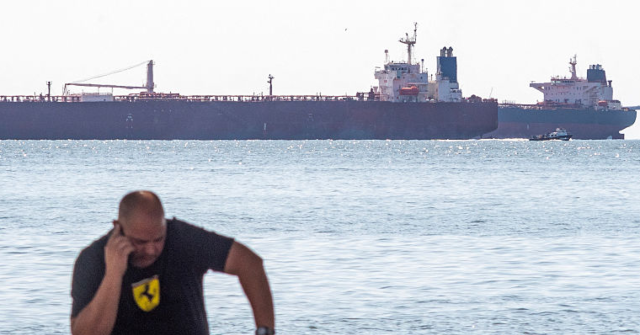
Maritime tracking data released on Monday showed that international oil tankers have dramatically scaled back loading activity at Venezuelan ports, fearful of a crackdown by the Trump administration on illegal sanctions-busting oil shipments.
The U.S. military has seized two oil tankers in the week since President Donald Trump announced a “blockade” on shipments of sanctioned oil from Venezuela, approached a third, and is currently shadowing a fourth.
These actions were evidently enough to make ship owners more nervous about taking on cargoes of Venezuelan oil. Reuters reported on Monday that Venezuela’s national oil company, PDVSA, has only loaded one major cargo of heavy crude to a docked tanker, and no others are currently scheduled to take on oil.
“The number of loaded tankers that have not departed has increased in recent days, leaving millions of barrels of Venezuelan oil stuck in ships, while customers demand deeper discounts and contract changes to take risky voyages beyond the country’s waters,” Reuters noted.
“Some tankers approaching Venezuela’s coast, either to load oil for export or to deliver imported naphtha, have also made U-turns or suspended navigation recently until instructions from owners to load are clarified,” Reuters added, citing maritime tracking data from the LSEG analytics firm.
Bloomberg News on Monday looked at a different set of data from maritime intelligence firm Kpler and concluded Venezuela’s oil terminals were not quite as paralyzed as Reuters suggested.
Kpler’s data said that about 14 vessels have loaded in Venezuela since the U.S. ramped up its “blockade” in mid-December — six of them ships under sanctions. Since these illegal vessels tend to sail as “ghost ships” with their transponders turned off, it was difficult for Kpler to determine all of their current positions, so some of them might not have set sail with their cargoes.
Lead Kpler oil analyst Matt Smith noted that Venezuela’s onshore oil facilities are filling up, suggesting that shipments are not occurring at the ideal pace, and some of the loading activity observed at Venezuela’s ports could be an effort to use stationary tanker ships as additional storage capacity.
In addition to the maritime interceptions, PDVSA is also struggling to recover from a cyberattack on December 15 that shut down much of Venezuela’s oil and gas infrastructure for three days. The company obliquely accused the U.S. government of orchestrating the attack, and some analysts believe no one else could have pulled it off.
“This is what U.S. Cyber Command was built to do. It sounds entirely plausible and is consistent with the mission and capabilities of U.S. Cyber Command,” an unnamed former federal cybersecurity official told Politico on Monday.
“If this is U.S. offensive cyber operations, then this is the perfect cyber complement to a maximum pressure campaign. Given enough time and opportunity the operation described would be well within U.S. capabilities,” said retired Rear Adm. Mark Montgomery, now senior director at the Foundation for the Defense of Democracies.
Read the full article here