



Nigerians speaking to the newspaper Daily Trust expressed extreme hesitation in traveling out of the capital city of Abuja to spend Christmas this week with family, citing the “insecurity” crisis caused by a growing wave of systematic attacks by jihadists against Christian communities nationwide.
While the report did not mention radical Islam, the Fulani “herdsmen” jihadists, or other known Islamist threats such as Boko Haram, Christian advocates in the country have repeatedly asserted that armed and organized Islamist terrorists have plagued Nigerian Christians for over a decade, massacring them indiscriminately and taking their land. Experts have accused the government, led by Muslim President Bola Tinubu, of actively denying the crisis and trying to absolve the Islamists by blaming the violence on unspecified “bandits” affected by climate change and claiming that the attacks affect all Nigerians equally, not just Christians.
“People were even warned not to say they are Fulani herdsmen who have been causing these atrocities such that when you open the general media they are talking about bandits – bandits or they say ‘unknown gunmen’ or things like that,” Father Remigius Ihyula of Benue state, Nigeria, told Breitbart News in 2023, “so you read about bandits. It’s rubbish: they are Fulani men going about with cattle and with guns and killing people and the government won’t do anything about it.”
While the terrorist violence has existed in Nigeria for years, the issue became an international concern after President Donald Trump announced in August that he would add Nigeria to the State Department’s lists of Countries of Particular Concern (CPC) for religious freedom, citing the genocidal attacks against Christians. Tinubu, the Nigerian president, responded by denying that any intolerance, much less targeted violence, against Christians existed in the country, then proceeded to declare a state of emergency in response to that targeted violence.
Nigeria’s President and Chairman of Economic Community of West African States (ECOWAS), Bola Ahmed Tinubu, leaves the Banquet Hall after being reinstated as the Chairman of ECOWAS on July 7, 2024. (SODIQ ADELAKUN/AFP via Getty Images)
The state of emergency and increase in the number of documented attacks, the Daily Trust detailed, are “forcing many families to postpone of cancel trips” during the holiday. Speaking to journalist Daniel Ariyo Oluwole, Nigerians in Abuja lamented that traveling by road to their home villages was too big a security risk to justify and air travel, likely in part because of increased demand, is prohibitively expensive.
“I would have loved to travel but, considering the insecurity in the country, I am giving it second thoughts,” one unnamed Nigerian, speaking to the Daily Trust podcast Nigeria Daily, explained. “The challenge has been finance, but right now the finance is no longer the challenge but the insecurity along the highway.”
The individual said that he researched flights to his hometown, but the cost upwards of 700,000 naira ($481.72).
“I’m considering sending money to family members for them to celebrate without me,” he added.
Another woman speaking to the podcast similarly stated she was “very scared” to travel anywhere and taking a flight to her home was about 300,000 naira ($206.45) one-way, similar to what the first witness stated.
“Personally, I’ve been very scared to travel. I planned to travel on the 23rd or 22nd … [but] looking at what’s going on the country, especially the things I’ve been seeing on the internet, I’ve been quite scared,” she shared.
“I don’t want to die young,” she concluded. “I’m not going to travel again, I’m just going to send them money to enjoy themselves in the village.”
An official in Kano state, one of the 12 states in Nigeria that has implemented sharia, or Islamic law, told the podcast that Kano was “very calm” at the moment and that travelers should be fear using its roads.
“Additional deployments have been done at highways,” the official claimed, “especially at strategic places where there are increased movements … The current security situation as stated is Kano is very peaceful, Kano is very calm.”
Supporting this reporting, the Christian Association of Nigeria (CAN) lamented in a statement on December 17 that Christians in the country are foregoing celebrations and travel out of fear.
“Sadly, information available to Northern CAN reveals that a large number of Christians are considering staying back in their places of residence out of fear for their safety, as highways, rural communities, and even places of worship have become targets of violent attacks,” the chairman of Northern CAN, Rev. Dr. Yakubu Pam, stated. Pam urged the government to increase its security initiatives to allow Christians to practice their religion.
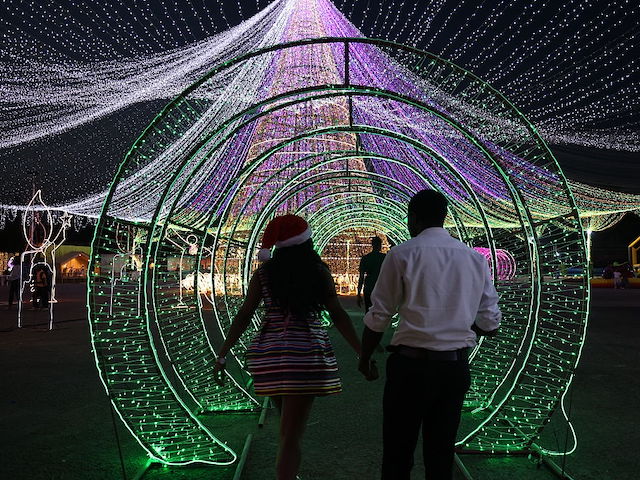
A general view shows streets and avenues decorated with illuminated ornaments as Abuja prepares for Christmas and New Year celebrations in Abuja, Nigeria, on December 8, 2025. (Photo by Emmanuel Osodi/Anadolu via Getty Images)
Nigerians have grown accustomed to heightened concerns about terrorism during Christian holidays, particularly Christmas and Easter. Nearly every one of the past ten years have experienced a large-scale string of jihadist attacks against Christians during the Christmas season. In 2024, Fulani terrorists attacked multiple communities in Benue state, killing 11 and disappearing many into captivity; reports at the time did not indicate a conclusive total of the missing. Benue is in Nigeria’s Middle Belt, the region that straddles the majority-Muslim north and the majority-Christian south.
In 2023, jihadists staged a massive attack in neighboring Plateau state, killing nearly 200 people and burning down over 1,000 homes, displacing 10,000 people.
“We have not less than 64 communities that have been displaced, and their lands have been taken over by these terrorists,” Plateau Governor Caleb Mutfwang lamented at the time. “I can tell you these schools that are being occupied, it didn’t just start now; some of those schools have been occupied in the last three, four, five years.”
In 2021, a similar wave of “bandit” attacks targeted residents of Zamfara state, abducting dozens on Christmas. In 2019, the Islamic State affiliated terrorist organization Boko Haram, which operates primarily in the country’s northwest, killed seven in a Christmas attack targeting Chibok, the town in Borno state made famous by the Boko Haram abduction of over 200 schoolgirls in April 2014.
Speaking at a briefing on Nigeria convened by the Christian human rights organization Open Doors that Breitbart News attended on December 16, Nigerian journalist Steven Kefas told reporters that his research on “bandit” attacks in Nigeria indicated not just that the terrorists tended to be more active during Christian holidays, but that they disproportionately targeted churches on Sundays, while being less active on Fridays, the traditional Muslim day of worship.
“The festive period are one of the times they like to attack the communities,” he explained, citing Christmas Eve specifically.
“In the last ten years, I’ve also discovered that most of the attacks in the Middle Belt take place on Sunday – it’s something I’ve documented personally, most of the attacks take place on Sunday or an eve to a particular Christian festival,” he continued. “If this is just random criminality, why not attack the Muslims in the Middle Belt on the eve of their celebration, or on Friday? You never hear that.”
Kefas added that Christians were also disproportionately represented among the victims in states that were majority Muslim, such as Kaduna state, a sharia state.
“Even where you have more Muslims in terms of population, you discover that the number of christians killed doesn’t justify the fact that it’s random violence, that its normal violence,” he emphasized.
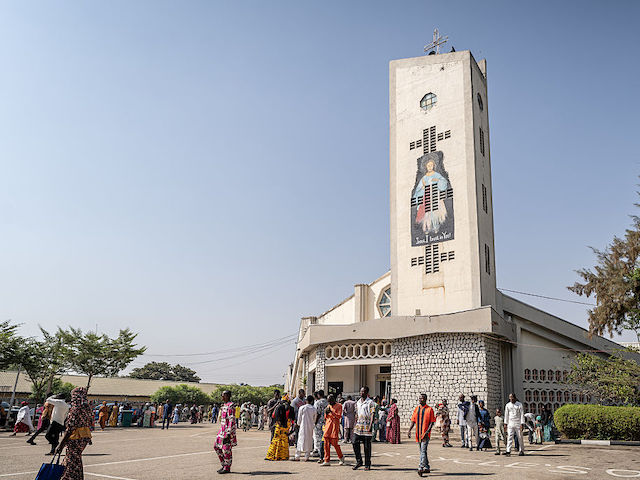
Catholics leave the Saint Michael’s Cathedral at the end of the Sunday’s service in Minna on November 30, 2025 as the congregation prayed for the safe return of the abducted students of Saint Mary’s Catholic School earlier this month. (Light Oriye Tamunotonye / AFP)
Nigeria enters the Christmas season following a November marked by brutality. The country’s National Human Rights Commission (NHRC) revealed on December 16 that it had documented nearly half a million human rights abuses in the country, the majority of them abduction-related. Agency leaders highlighted that November 2025 saw the highest documented number of schoolchildren abductions since April 2014, the month of the Boko Haram Chibok kidnapping.
At an event in Washington, DC, this month, the aid organization Equipping the Persecuted warned that evidence indicated that jihadists were planning a wave of attacks for Christmas day.
“We got very reliable information that they are weaponising for a Christmas Day massacre,” organization founder Judd Saul warned, according to Nigeria’s Punch newspaper. “I am imploring the Nigerian government and President Donald Trump to do something so we don’t have a bunch of dead Christians in Nigeria.”
Saul suggested the jihadists were “gathering forces around the Plateau and Nasarawa border, along the Nasarawa-Benue border and along the Nasarawa-Kaduna border. They are planning to hit on Christmas Day in Riyom, Bokkos, Kafanchan and Agatu.”
Punch noted that the Nigerian government claimed to be aware of the attack but nonetheless disparaged Equipping the Persecuted.
“We should be very careful how we digest and process some of these doubtful reports by external organisations who are setting a stage for internal crisis in our country,” a senior Tinubu aide, Temitope Ajayi, was quoted as saying. “We should not be providing oxygen for reports that heighten a sense of insecurity in our country.”
“Nigerians should not entertain any fear in any part of the country. The police and the military are working to ensure we have a peaceful Christmas and Yuletide season,” he insisted.
Follow Frances Martel on Facebook and Twitter.
Read the full article here