


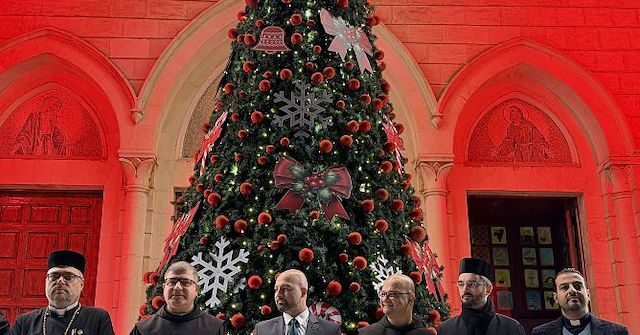
The Syrian Arab News Agency (SANA), now under the control of Islamist President Ahmed al-Sharaa, has published weeks of content showing throngs of jubilant Christians in the country enjoying Christmas tree lightings, holiday markets, and other celebrations – a nod to the White House that Sharaa will respect religious tolerance.
Sharaa, who has met with President Trump twice and repeatedly vowed to protect religious freedom in the country, has reportedly amplified security around Christian celebrations in Damascus. Yet many Christians in Syria still live in fear a year after the fall of Iran-backed dictator Bashar Assad, failing to forget Sharaa’s history as an al-Qaeda affiliated jihadist and fearing attacks in parts of the country still not solidly in control of Sharaa’s administration.
Once known as “Abu Mohammed al-Jolani,” Sharaa began his jihadist career under al-Qaeda but ultimately split from the group and founded a militia known as Hayat Tahrir al-Sham (HTS), an explicitly jihadist organization designated as terrorist by the American government. HTS focused closely on vanquishing the Assad regime and succeeded on December 7, 2024, when the dictator and his family fled to Moscow. At the time, Christian persecution experts called Sharaa’s rise a “disaster for Christians” and feared that he would used his power to exterminate the already significantly reduced Christian population. Sharaa indeed imposed an Islamist constitution on the country and has defended the use of political Islam to government but, in pursuit of Western foreign investment, has also repeatedly claimed to run a regime tolerate of non-Muslims.
In an apparent move to promote that image as an “inclusive” ruler, Sharaa’s SANA has spent the past month publishing images and videos of Christmas celebrations in Damascus, Homs, Idlib, Latakia, and other major population centers, suggesting that post-Assad Syria is a safe place for Christians. Syria is the setting of many of the most pivotal developments in early Christianity and was once home to one of the world’s most vibrant Christian populations, but that community has been almost entirely destroyed by over a decade of civil war and attacks by genocidal jihadists groups such as the Islamic State.
In Idlib, Christians lit a nativity display and Christmas tree in al-Quniyah, a celebration SANA claimed attracted visitors from surrounding villages. The state media outlet made a point of quoting the parish priest Father Khokaz Misrob, who told the outlet, “we hope that the light of this blessed holiday will shine over Syria after fourteen years of suffering.”
In the nation’s capital, Christians enjoyed a large-scale Christmas bazaar as well as choral performances and a procession featuring local children.
“Handmade and woolen products, wooden artifacts, icons, and various Christmas decorations adorned the ambiance of the Christmas bazaar held at the Cathedral of Our Lady of the Dormition in Damascus,” the state media outlet reported on December 20. “Beyond commerce, the bazaar reflects the resilience and solidarity of Syrian society, turning holiday markets into symbols of community cooperation and hope.”
SANA also highlighted a Christmas celebration in Homs, one of the governates most devastated by the Syrian Civil War.
“Attendees expressed their delight at the celebration, saying that the event helped create a joyful atmosphere and highlighted the deeper meanings of Christmas—love, hope, and the celebration of the birth of Jesus Christ,” state media shared.
Similarly, SANA highlighted Christmas events in Latakia, notable as the coastal governate was a key Assad stronghold for much of the war.
Ryan Brown, the CEO of the human rights organization Open Doors, told Breitbart News that many Christians in Syria still fear openly practicing their faith, as the perceived threats come not just from the Sharaa government.
“Unfortunately, the ability to openly celebrate or worship is not a sentiment shared by all Christians in Syria this Christmas,” Brown explained. “The fall of the Assad regime created a number of vacuums in power. Militants and those opposed to Christians have been opportunistic to step into those vacuums to drive their agendas.”
“As a result, many Christians have fled Syria. Instances like the Mar Elias church attack this summer have had a profound impact on those still present. The church is shrinking, and many of those who remain feel under threat,” he explained.
The Mar Elias Church in Dweil’a, outside of Damascus, suffered a suicide bombing on June 22 that killed 25 people and injured dozens of others. The Syrian government identified the attacker as a member of the Islamic State terrorist group.
“To follow through in their stated intentions,” Brown indicated, “the new government will need to bring presence and stability to some of these vacuums in ways that truly allow people of all faiths to feel secure. Unfortunately, many feel the Syrian government has not yet been able to fulfill that guarantee.”
The Syrian Observatory for Human Rights (SOHR), which documents human rights abuses and threats in the country, reported on December 22 that Sharaa has attempted to improve security at Christian sites in anticipation of the holiday.
“SOHR activists have reported the units of internal security forces of the transitional government have been put up high alert in the capital, Damascus, since yesterday,” it noted. “This coincides with heavy deployment by security forces in front of major churches and religious centres, as well as running patrols in predominantly-Christian neighbourhoods.”
The SOHR noted that locals considered apparent attempts to protect Christian spaces “a positive sign.” The move follows multiple incidents alarming Christians in the country however, beyond the Mar Elias bombing. In Wadi al-Nasara, a Syrian region whose name translate to the “Valley of the Christians,” locals complained of neglect or worse from the government, particularly in the face of a perceived lack of response to protect Christians from rampant wildfires that erupted there in September.
A report published in November by the French organization L’Œuvre d’Orient found a precipitous collapse in the Christian population of Syria. As narrated by Zenit:
Deir Ezzor, once home to 7,000 Christians, now counts only four. Nationwide, the war has killed more than 520,000 people, displaced millions internally, and forced around seven million into exile. While all Syrians have suffered, Christian neighborhoods—often located along front lines or targeted by Islamist groups—were hit particularly hard. In Aleppo, only about one-sixth of the pre-war Christian population remains. Overall, an estimated 300,000 to 400,000 Christians are still in Syria. Of those who remain, more than half are over the age of 50.
The Christian population of Syria is believed to stand at around half a million, over two-thirds smaller than it was before the Syrian Civil War began in 2011.
Follow Frances Martel on Facebook and Twitter.
Read the full article here