


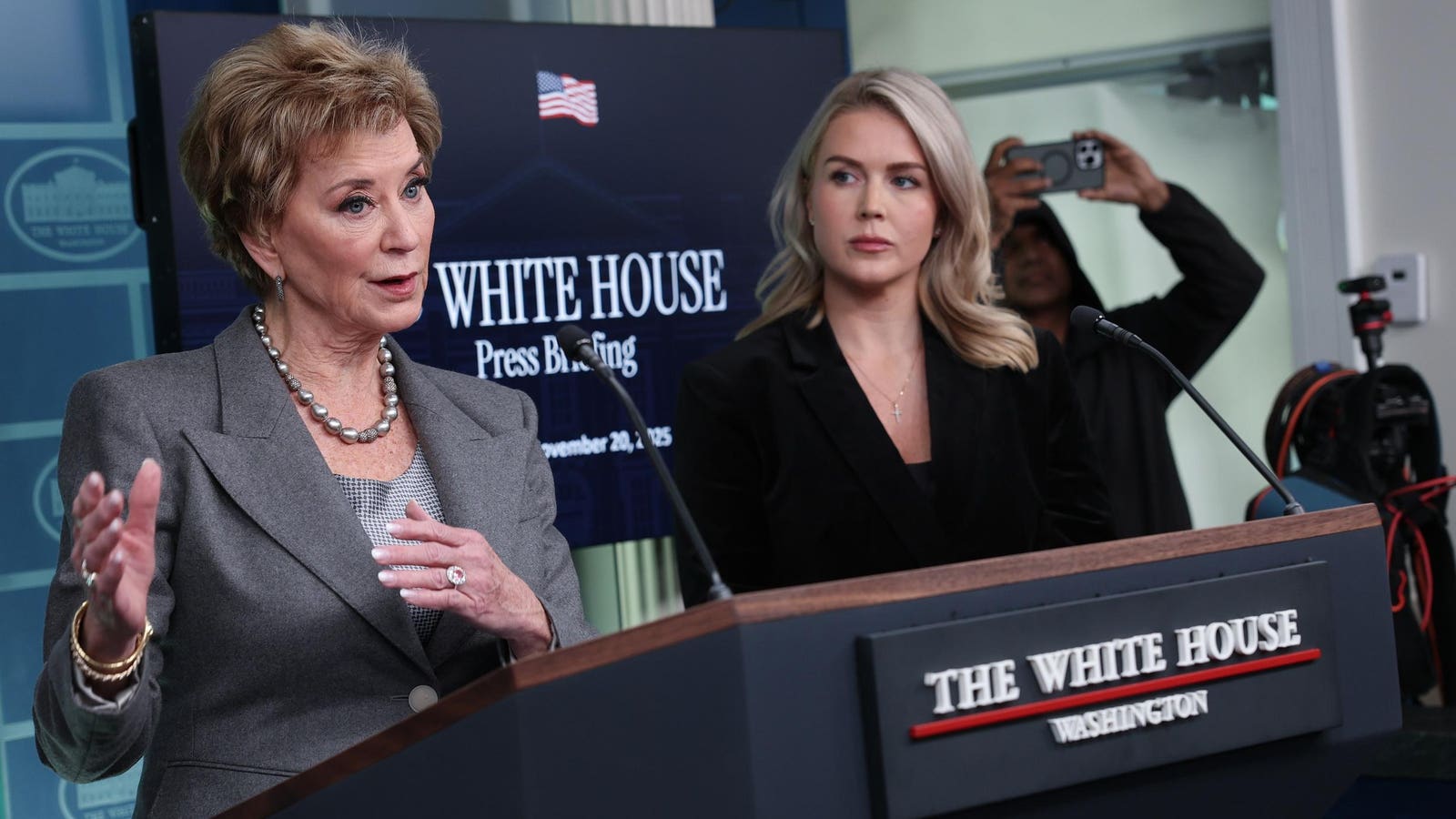
WASHINGTON, DC – NOVEMBER 20: Secretary of Education Linda McMahon (L) speaks during a White House press briefing with White House Press Secretary Karoline Leavitt (R) on November 20, 2025 in Washington, DC. McMahon addressed questions related to a recent initiative by the Trump administration to largely dismantle the Department of Education. The department is also moving forward to implement changes to student loans under the One Big, Beautiful Bill Act. (Photo by Win McNamee/Getty Images)
Getty Images
The federal student loan system has already undergone significant changes during the last year. But additional major reforms are on the way, with the next wave of big changes set to begin impacting student loans in only a few weeks.
The tumult associated with the federal student loan system is due to a combination of factors. Multiple legal challenges and associated court rulings have blocked some programs (such as the SAVE plan), while allowing relief under other programs (such as student loan forgiveness under the IBR, ICR, and PAYE plans) to continue. In the meantime, the Education Department is moving forward to implement several student loan-related elements of the One Big, Beautiful Bill Act, or OBBBA, that congressional Republicans and President Donald Trump enacted last summer.
Here’s what borrowers should know about the major changes to student loan forgiveness and repayment plans that are on the horizon.
IBR Plan Set To Expand For Federal Student Loans By End Of December
One of the early changes to student loans mandated by the OBBBA is the expansion of the Income-Based Repayment, or IBR plan, for higher earners. Under the OBBBA, the Department of Education will phase out the ICR, PAYE, and SAVE plans no later than July 2028, while keeping IBR intact. The department will also create a new income-driven plan called the Repayment Assistance Plan, or RAP, later next year. So, when the dust settles, there will be just two repayment plans tied to a student loan borrower’s income: IBR and RAP.
To ensure that borrowers on track for student loan forgiveness under the sunsetting plans can maintain their progress, the OBBBA mandates the removal of a “partial financial hardship” requirement associated with the IBR plan. That requirement has meant that borrowers whose incomes were too high relative to their student loan balances were unable to enroll in IBR. The removal of the partial financial hardship requirement should now allow these borrowers to access IBR.
However, the Education Department did not immediately effectuate this change in their application system. That has resulted in some student loan borrowers applying for IBR getting rejected because they don’t have a partial financial hardship. The issue wound up being included in an expanded legal challenge filed by the American Federation of Teachers against the department and Education Secretary Linda McMahon earlier this fall.
In an agreement to resolve that lawsuit, the Education Department confirmed that it would update its systems to implement the removal of the partial financial hardship requirement for IBR. The department expects to complete these updates by the end of December, according to updated guidance on the department’s website. In the meantime, borrowers with IBR-eligible student loans who were rejected due to the partial financial hardship rule should reapply, says the department, and their application will be held until processing can go forward.
Forgiveness Of Student Loans Under IDR Plans Becomes Taxable Again In January
Congressional Republicans did not extend tax relief associated with IDR student loan forgiveness in the OBBBA. That means that loan forgiveness at the 20- or 25-year mark under the IBR, ICR, and PAYE plans goes back to being a potential taxable event for borrowers starting on January 1, 2026.
Generally, any form of debt cancellation or loan forgiveness can be taxable. The lender would issue an IRS Form 1099-C, requiring the borrower to report the amount of cancelled debt as if they earned it income on their tax return. They may then have to pay taxes on that additional “income.” And a significant amount of cancelled debt could result in substantial tax liability.
Student loan forgiveness under IDR plans has historically been treated as taxable. But the American Rescue Plan Act of 2021 temporarily exempted all federal student loans from being treated as taxable upon discharge until the end of 2025. Because the OBBBA does not extend this relief, however, IDR loan forgiveness goes back to being taxable again starting in January. Other forms of student loan forgiveness, such as Public Service Loan Forgiveness and cancellation through the Total and Permanent Disability Discharge program, remain tax-free federally.
Under an agreement with the American Federation of Teachers to resolve the union’s expanded legal challenge over IDR and loan forgiveness processing issues, the Education Department agreed to not issue Form 1099-C’s to any borrower whose student loans reach their IDR eligibility milestone for forgiveness by the end of 2025, even if their actual discharge doesn’t occur until sometime next year. Borrowers in the SAVE plan who qualify for student loan forgiveness now should apply to switch to one of the other income-driven plans (ICR, IBR, or PAYE, depending on eligibility) by December 31, 2025 to lock in that tax relief, suggests the agreement.
Borrowers who expect that their student loans will reach discharge eligibility in 2026 or later should consult with at tax advisor about the possible tax consequences associated with student loan forgiveness. There may be other ways of possibly reducing or eliminating tax liability (such as through the insolvency exemption, if the borrower’s assets exceeds the value of their debts). Borrowers should also be mindful of potential state tax consequences, as well.
Other Changes To Student Loans Begin Taking Effect During 2026
Additional changes to federal student loan forgiveness and repayment will start going into effect after January 2026:
- Undergraduate and graduate students will be subject to new borrowing limits on federal student loans starting on July 1, 2026. That could hinder the ability of borrowers and their families to finance their degree program.
- Parent PLUS borrowers who do not consolidate their loans via the federal Direct consolidation program by July 1, 2026 will be cut off from any income-driven repayment option, and effectively, student loan forgiveness as well (since enrolling in an IDR plan is typically required to pursue time-based loan forgiveness). Importantly, Parent PLUS borrowers must complete their Direct loan consolidation before July 1 of next year; since it can take anywhere from 30 to 90 days (and sometimes longer) for Direct loan consolidation loans to be funded after submitting an application, Parent PLUS borrowers effectively only have a window of a few months to act. Parent PLUS borrowers must then take additional steps to preserve access to IDR and student loan forgiveness, including enrolling in the ICR plan and making at least one payment under ICR prior to July 1, 2028. Only then will they be permitted to then apply to switch to the IBR plan, given that ICR will be phased out.
- The RAP plan is expected to debut around the same time, the summer of 2026. It is quite possible that borrowers in the SAVE plan forbearance (during which no payments have been required for applicable student loans covered by the forbearance) may be forced to change to a different repayment plan at around this time, as well, depending on the outcome of the ongoing litigation involving the SAVE plan.
Ultimately, borrowers should take stock of their student loans and make the time to understand the big changes that are coming as the Education Department implements the OBBBA. The stakes are high for at least some borrowers, and making the right moves now could preserve access to affordable payments and eventual student loan forgiveness.
Read the full article here