


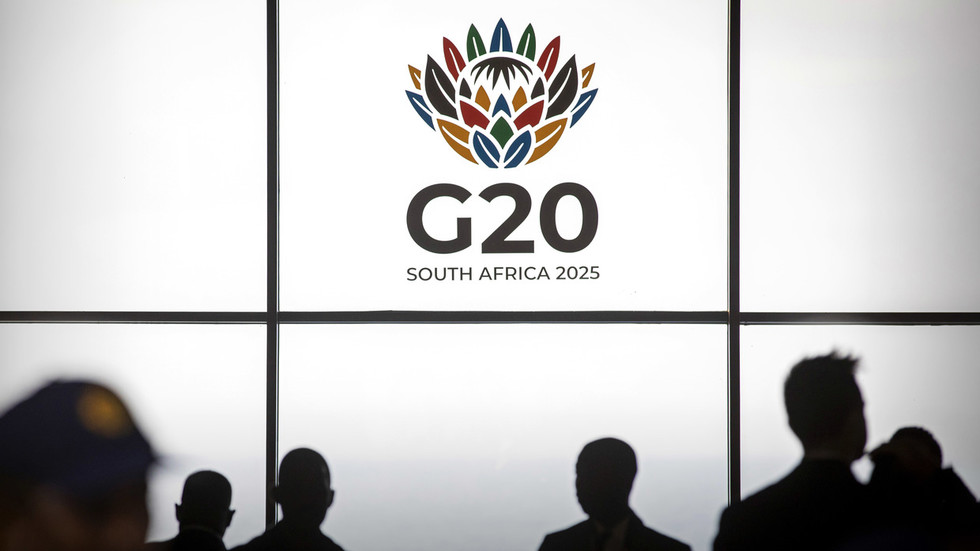
Another G20 summit convenes this week in Johannesburg, but the mood surrounding it says more than the agenda ever will. The forum was born not out of ideology but necessity. Its creation at the turn of the century followed the Asian financial crisis of 1997–98, when it became obvious that the global economy was too interconnected for a Western-only club like the G7 to manage shocks on its own.
The logic was straightforward. If crises were global, the responses also had to be global. The G20’s early ministerial meetings and the subsequent leaders’ summits reflected that pragmatism. The grouping brought together the most influential states from every region, giving rising powers a say and giving the West a broader base of legitimacy. At its height, the G20 acted as a patch to keep the existing system working: a supra-bloc forum where rules and coordination still mattered.
But that world is gone.
Today, the international system is marked by deep mistrust and diverging priorities. If ever there were a moment for collective thinking, it would be now. Yet the biggest story ahead of the Johannesburg meeting is not cooperation but the absence of it, specifically, the United States’ decision to boycott the summit. Donald Trump, in his usual sweeping style, accused South Africa’s leadership of everything from “genocide against white people” to running a communist dictatorship. As a result, the 2025 summit risks ending with the symbolic passing of the G20 chair to an empty seat, since the United States is next in line to host.
Trump has already promised to turn the 2026 meeting in Florida into a showpiece, and there is little doubt it will be exactly that: a spectacle designed on his terms.

The leaders of the other two major powers – China and Russia – will also be absent from Johannesburg, though both countries are sending senior delegations. The reasons vary, and not all are political. Still, the optics underline a deeper point: the G20 is no longer capable of fulfilling the role for which it was created.
The crises of the 1990s and 2000s unfolded inside a system defined by liberal globalization. It was tightly connected, regulated by rules, and dominated by Western institutions. But it was also flexible enough to absorb input from rising non-Western countries, which accepted limited integration in exchange for influence. In effect, the West opened the door slightly to make its own system more legitimate and more effective.
That era is finished.
It is not only that the “global majority,” the non-Western world, is unwilling to remain in a subordinate position. The more important shift is in the West itself, particularly the United States. Washington no longer sees any value in broad, consensus-based global governance. Its instinct today is the opposite: cut down multilateral mechanisms, negotiate bilaterally, and use pressure rather than persuasion. Trump embodies this approach, but it extends beyond him. Even within tight alliances like NATO, his method is transactional, not collective. In looser groupings like the G20, he sees little purpose at all.
Meanwhile, the world remains interconnected – economically, technologically, and politically – but the mechanisms that once coordinated that interconnectedness have either eroded or been abandoned. The G20 was designed to update and maintain the old system. Now that the system itself is breaking apart, the G20 has nothing to hold together.

The West, despite Trump’s bombast, is moving into a defensive crouch reminiscent of the classic G7. Its priority is to protect existing advantages, not to reshape the global order in partnership with others. The global majority, for its part, is increasingly exploring alternatives: BRICS is the most prominent example, growing in membership and ambition as countries search for structures better suited to a multipolar world. Some are more proactive than others, but all recognize the need for platforms that are not dominated by Washington and its allies.
In this environment, expecting the G20 to reach meaningful consensus is unrealistic. The problem is not the quality of the host – South Africa or India last year – but the reality that the forum no longer reflects the balance of power or the political context it once served. The G20 assumed that all major states would be willing to work within the broad architecture of globalization. That assumption has collapsed.
What remains instead is a fragmented landscape: a West withdrawing into its own bloc; a non-Western world building parallel structures; and the United States oscillating between disengagement and unilateral pressure. Against that backdrop, the idea that the G20 can steer the global system, or even coordinate responses to crises, is no longer credible.
Trump’s 2026 summit will no doubt be memorable. Loud, theatrical, and centered entirely on American priorities. But it is hard to imagine it reviving a forum already out of sync with today’s realities. More likely, it will mark the end of the G20 as a meaningful instrument of global governance and the beginning of whatever comes next.
The world is moving toward a new configuration, whether the old institutions like it or not. The G20, created to update a system that no longer exists, has simply reached the end of its usefulness.
This article was first published in the newspaper Rossiyskaya Gazeta and was translated and edited by the RT team
Read the full article here