


The Fed Was Misled by Its Tarifflation Convictions
The Federal Reserve spent 2025 worried about the wrong problem.
All year, officials treated President Trump’s tariffs as an inflation threat, a supply shock that risked pushing prices higher and complicating the central bank’s effort to bring inflation back to target. When the administration announced broad duties on foreign goods, the Fed’s instinct was caution: don’t cut rates too quickly, watch for tariff-related price pressures, keep policy tight enough to guard against a potential inflation flare-up.
“Higher tariffs are pushing up prices in some categories of goods, resulting in higher overall inflation,” Fed Chairman Jerome Powell said at his press conference in late October. “A reasonable base case is that the effects on inflation will be relatively short lived—a one-time shift in the price level. But it is also possible that the inflationary effects could instead be more persistent, and that is a risk to be assessed and managed.”
Back in July, he explicitly said the Fed was holding back on rate cuts because of tariffs.
“In effect we went on hold when we saw the size of the tariffs,” Powell said. “Essentially all inflation forecasts for the United States went up materially as a consequence of the tariffs.”
It was the sort of reasoning that sounds prudent. But it was also, according to new economic research, exactly backward.
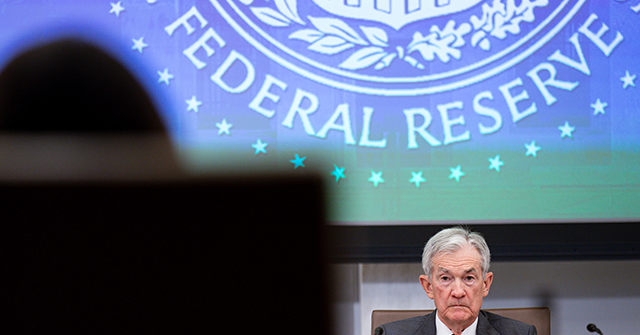
Fed Chairman Jerome Powell attends the Federal Reserve Board open meeting in Washington, DC, on Oct. 24, 2025. (Al Drago/Bloomberg via Getty Images)
Tariffs Are Disinflationary
The San Francisco Federal Reserve Bank has just published a sweeping historical study of tariff policy stretching back 150 years. The study, by economists Régis Barnichon and Aayush Singh, examines major tariff hikes in the United States, Britain, and France, at moments when governments, like the Trump administration, significantly raised barriers to imports. Their finding is stark and runs directly against the Fed’s stance: tariff increases are followed by lower inflation and higher unemployment, not the reverse.
A typical large tariff hike—roughly a four percentage-point rise in the average tariff rate—shows up in the pre-World War II historical record as associated with about two percentage points less inflation and one percentage point more unemployment. The authors of the paper admit that they do not know exactly how this works but note that it is akin to what you would expect from a decline in demand.
That is the opposite of what the Federal Reserve told itself about tariffs in 2025.
To understand how consequential this misreading is, start with a simple principle: when policymakers get the sign of an economic shock wrong, when they mistake its direction, they naturally respond in the wrong direction too.
The Fed saw tariffs and thought: inflation risk. That judgment led it to be cautious about rate cuts, to second-guess aggressive easing, to treat any sign of economic strength as a reason to hold back. If tariffs genuinely were inflationary, that would make sense. Keep policy tight. Guard against a wage-price spiral. Don’t loosen just because there are downside risks showing up in the labor market.
But if the San Francisco Fed’s 150-year study is right, tariffs push the economy in the opposite direction. They’re disinflationary. They weaken employment while pushing prices down, perhaps because demand weakens or perhaps because they shift the economy onto a higher productivity path. One way to understand this is that tariffs appear to act, in effect, like an extra monetary tightening that the central bank should offset with easier money, not reinforce with caution.
So, the Fed in 2025 faced a tariff shock that was already pulling inflation down and unemployment up. Its response was to keep policy tighter than it otherwise would have. The result was two tightenings working in the same direction—tariffs pushing down on employment and prices, and the Fed also pushing down for fear of the inflation that never came.
The Fed was so convinced of its view that tariffs are inflationary that it ignored evidence to the contrary. Prices of durable goods are up 1.8 percent from a year ago, hardly a scarily inflationary trend. Prices of major appliances are down 1.6 percent. Apparel prices are down 0.1 percent. New car prices have climbed 1.2 percent, and new truck prices inched up 0.7 percent. The Fed looked at all this and concluded that it just meant tariff inflation was still looming.
A Policy Error That Cries Out for Correction
You don’t need to think this produced a catastrophe to see the error. It means the Fed likely held rates higher than necessary for longer than was optimal. The labor market cooled more than it needed to. The housing market remains frozen because of high rates. Some of the disinflation achieved in 2025 came not just from the tariffs themselves but from the Fed’s decision to treat tariffs as inflationary and hold back on cuts.
If the Fed had correctly seen tariff hikes as disinflationary shocks that modestly weaken the demand for labor, the response would be to ease monetary policy more aggressively, not less. The mantra would shift from “tariffs are a reason to be cautious about rate cuts” to “tariffs are doing some of the Fed’s tightening work for us, so we should do less ourselves.”
Instead of asking, “How do we keep inflation from spiking because of tariffs?” the Fed would ask, “How do we offset the disinflationary and employment-dampening effects of tariffs with easier monetary policy?”
Those are radically different questions. They lead to radically different policy paths.
In practice, this would have meant the Federal Reserve cutting rates more decisively in 2025, leaning harder against the labor market softening effects of the tariff shock, and treating the tariff-plus-lower-rates combination as complementary rather than contradictory. The Fed would have been a partner in an economic program, rather than a skeptic holding back against it.
The question now is whether Fed officials are willing and able to update their views to reflect the research or whether they’ll keep making the same mistake.
Read the full article here