




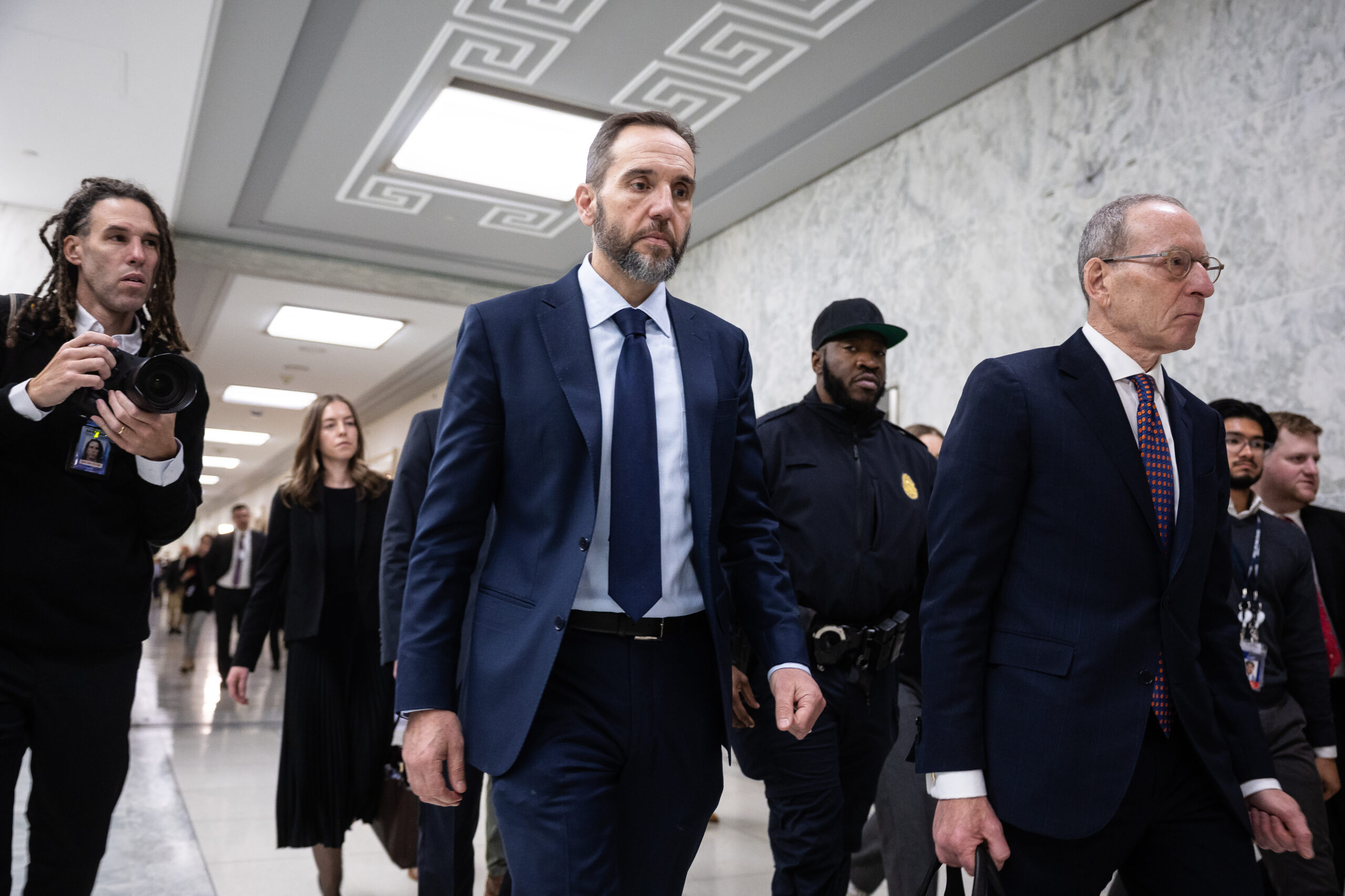
House Republicans decided to publicly release the transcript of special counsel Jack Smith’s Dec. 17 closed-door deposition on New Year’s Eve — while most of Washington was tuned out for the holiday.
Smith used the day-long grilling before the House Judiciary Committee to mount a robust defense of his investigation into Donald Trump for seeking to subvert the 2020 election. He forcefully rebutted claims that his work was tainted by politics and delivered a granular defense of his office’s tactics and prosecution strategy — all while repeatedly restating his view that Trump was guilty of a historic crime. He also revealed some new information about his witness list, and gave Judiciary Republicans a new opening to attack Cassidy Hutchinson’s infamous testimony.
A spokesperson for Smith declined to comment.
Here’s what we learned from the 255-page transcript:
Smith built his case around Trump’s allies
Some of Smith’s most substantive testimony centered on his never-implemented trial strategy: using Republicans who believed in Trump to make the case against him.
“The president was preying on the party allegiance of people who supported him,” Smith said. “The evidence that I felt was most powerful was the evidence that came from people in his own party who … put country before party and were willing to tell the truth to him, even though it could mean trouble for them.”
Smith repeatedly drew on diehard Republicans to make the case against the man they wanted to become president but who they acknowledged had been defeated. Smith said former Vice President Mike Pence and several of the GOP elector nominees — like Pennsylvania’s Lawrence Tabas — would have fit that bill and made strong trial witnesses.
“That witness, Mr. Tabas, was of a similar group of witnesses who — these are not enemies of the president. These are people in his party who supported him,” Smith continued. “And I think the fact that they were telling him these things … would have had great weight and great credibility with a jury.”
Smith said he came to believe that Trump’s Jan. 6, 2021, tweet attacking Pence while he was at the Capitol “without question” exacerbated the danger to Pence’s life.
Smith hadn’t made his final charging decisions
The former special counsel said he never officially decided whether to bring additional charges against the figures he alleged were Trump’s co-conspirators — including attorneys Rudy Giuliani, Sidney Powell, Kenneth Chesebro, John Eastman and Boris Epshteyn.
“I had not made final determinations about that at the time that President Trump won reelection, meaning that our office was going to be closed down,” Smith said.
Smith said he had no plans to call Eastman — an architect of Trump’s last-ditch bid to stop Joe Biden’s Electoral College certification in January 2021 — as a trial witness but said he would have welcomed Trump calling Eastman to the stand as a defense witness.
Smith noted he interviewed Epshteyn, Giuliani and other alleged co-conspirators in the course of the investigation.
Lawmakers failed to knock Smith off his game
The former special counsel repeatedly leaned into the defense of his probe and expressed confidence that a jury would have convicted Trump if the case went to trial.
He refused to take Democrats’ bait to attack Republicans for refusing, so far, to give him a public hearing. And he avoided straying into discussions that might have forced him to reveal subjects still protected by grand jury secrecy or a federal judge’s order that barred him from disclosing details of his second investigation into President Trump’s hoarding of classified documents at Mar-a-Lago after leaving office in 2021.
“Did you have the opportunity to interview Mr. Pence as part of your investigation?” a staffer asked Smith at one point.
“I think the answer to that question might involve [grand jury information], and so I’m not going to answer that,” Smith said.
When Rep. Dan Goldman (D-N.Y.) pressed Smith about the structure of his classified documents report, Smith again demurred.
“I don’t think I should even talk about that. I don’t want to have any — any implication that I gave some sort of insight about how that report is constructed,’ he said.
Smith repeatedly reminded lawmakers that he’s open to sharing the results of his classified documents investigation, but was restricted by the ruling from a federal judge in Florida who maintained Smith’s report must stay under seal. The day of Smith’s deposition, the Department of Justice also sent an email to Smith’s team emphasizing the court order prevented him from sharing nonpublic information with Congress.
At one point, a staffer questioning Smith suggested it would be far more difficult to retrieve materials from Mar-a-Lago compared to elsewhere.
“I mean, a person can’t just walk into Mar-a-Lago and try to abscond with these materials, right?” the person, whose identity was redacted, asked.
“I would very much like to answer that question, but I cannot answer that question due to the final report,” Smith responded.
Smith forcefully rejected any hint of political bias
Republicans and Democrats repeatedly teed it up for him: Did politics influence Smith’s decision to become special counsel or the way he handled his investigation? Did the White House ever lean on him or senior Justice Department officials like former Attorney General Merrick Garland and his deputy Lisa Monaco?
Each time Smith was unequivocal: Not for a moment.
Smith maintained he never communicated with Biden or White House staff before or during his investigation. He also said the timing of Trump’s announcement for president, his crowded calendar of criminal cases leading up to the 2024 election and the sensitivity of certain allegations were nonfactors in his decisions. He emphasized that he regularly consulted with Justice Department officials to ensure he abided by its guidelines.
“We certainly were not in any way intending to affect the outcome of the election. And to make sure we complied with the policy, we met with Public Integrity to make sure we were doing that,” Smith said.
Multiple people also asked Smith if he would be surprised if Trump directs his Department of Justice to target him. The former special counsel responded no.
“I have no doubt that the president wants to seek retribution against me,” Smith said.
Lawmakers also pressed Smith about the executive order against his legal representation, Covington & Burling, in which Trump suspended security clearances for firm employees who had worked with Smith. It was one of several major law firms hit with penalties in the beginning of the second Trump administration.
“I think it’s to chill people from having an association with me,” Smith said.
Smith didn’t pursue ‘uncooperative’ witnesses
Though there were few new details in Smith’s testimony, he disclosed that he didn’t pursue interviews with three figures close to Trump: Steve Bannon, Roger Stone and Peter Navarro. The reason, he said, was they were relatively uncooperative with congressional investigators and were unnecessary for his team to discern the details of Trump’s bid to subvert the 2020 election.
“Given the highly uncooperative nature of the individuals you talked about, I didn’t think it would be fruitful to try to question them,” Smith said. “And the sort of information that they could provide us, in my view, wasn’t worth immunizing them for their possible conduct.”
But Smith also described a text exchange between Bannon and Epshteyn on the evening of Jan. 6 in which Bannon described Trump as “still on fire” — an exchange he said was evidence that Trump did not see the riot as the end of his effort to prevent his defeat in the election.
Smith defends pursuit of lawmakers’ phone records
Republicans and Democrats pressed Smith extensively about his pursuit of the phone records of Republican lawmakers who Trump and his allies contacted during the days and weeks before Jan. 6, 2021.
Smith said he wanted former Speaker Kevin McCarthy’s records because he knew McCarthy spoke to the White House as violence unfolded that day. He also said the records they pursued were limited and intended to shore up the case if it went to trial — and all were obtained in accordance with DOJ policies governing the handling of investigations that touch on congressional records.
Smith also emphasized he was not special counsel when Justice Department investigators obtained a two-year batch of House Judiciary Committee Chair Jim Jordan’s phone records.
The former special counsel displayed detailed knowledge about the way the Constitution’s Speech or Debate clause protects legislative activity from federal investigators and said he sought to comply with those limits. He noted that his office litigated Speech or Debate issues related to Pence and Rep. Scott Perry (R-Pa.) during the course of the probe.
“My office and I personally take the protections of the Speech or Debate Clause seriously,” he said. “They’re an important part of separation of powers.”
House GOP revel in Smith comments on Cassidy Hutchinson
In the aftermath of the transcript’s release, the Judiciary Republicans pointed to Smith’s comments about Cassidy Hutchinson, the former White House aide who in 2022 testified against Trump in a dramatic hearing before the Democratic-led Jan. 6 committee.
Hutchinson famously said another Trump aide told her that a furious Trump lunged for the wheel after learning the vehicle he was in was headed for the White House instead of the Capitol after his incendiary Jan. 6 speech. Trump has long denied the incident.
Smith told congressional investigators his office spoke to at least one officer who was in the SUV for Trump’s return to the White House that day.
“[M]y recollection with Ms. Hutchinson, at least one of the issues was a number of the things that she gave evidence on were secondhand hearsay, were things that she had heard from other people and, as a result, that testimony may or may not be admissible, and it certainly wouldn’t be as powerful as firsthand testimony,” Smith said.
“The partisan January 6th Committee’s ENTIRE case was just destroyed by… Jack Smith,” the Judiciary GOP posted on X. “Star witness completely unreliable!”
The Jan. 6 committee grilled Hutchinson in part because Mark Meadows, her direct boss, declined to sit for an interview. Though Hutchinson’s story was among the most explosive aspects of its public hearings, the case the committee made — that Trump systematically attempted to sow doubt about the 2020 election results and lean on state and federal officials to subvert it — was the product of hundreds of interviews, many from Trump’s closest aides and allies.
Read the full article here


