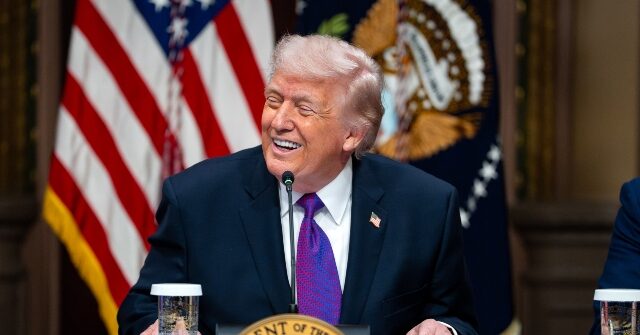
Leaders from the leading companies in AI including Google, Microsoft, Meta, Oracle, xAI, OpenAI, and Amazon have signed a non-binding agreement at the White House committing to fund the electricity infrastructure needed for their data center operations.
Data Center Dynamics reports that the CEOs of seven leading technology companies have signed a ratepayer protection pledge at the White House, promising to build or purchase the electrical generation capacity required to power their data centers. The agreement also covers the transmission and distribution infrastructure necessary to connect this power to the electrical grid.
President Donald Trump, speaking at the signing ceremony, stated that the pledge would reduce utility bills significantly. He emphasized that the measure would have a substantial impact on electricity costs, adding that the administration is working to bring down costs across the board.
Trump’s AI czar, David Sacks, described the importance of the deal in a post to X:
This is a much better approach to affordability than Bernie Sanders’ total ban on new data centers, which would halt the construction boom currently driving wage growth and job growth for blue-collar workers. In fact, the Ratepayer Protection Pledge will lower electricity prices when AI companies pay for grid upgrades and sell their excess power back to the grid. Since the beginning of his second term, President Trump has championed the idea of letting our leading AI companies become power companies, and now this idea is becoming a reality thanks to his leadership and the commitments of these strong American companies. The right approach to data centers is not to stop progress altogether, but rather to protect residential rate payers from price increases, while making it easier to stand up new power generation.

The pledge addresses growing concerns that the rapid expansion of data centers driven by AI development could lead to increased electricity bills for residential consumers. During his State of the Union address, President Trump argued that such protective measures were necessary to shield consumers from bearing the cost burden of the technology sector’s infrastructure expansion.
The White House has been increasingly focused on this issue since the beginning of the year. Last month, President Trump revealed that his administration had been conducting active discussions with data center companies to ensure that household electricity prices would not rise due to the AI infrastructure buildout. Microsoft was the first company to agree to these terms.
In response to the administration’s concerns, Microsoft launched an initiative called Community-First AI Infrastructure. Under this program, Microsoft committed to paying its own way to ensure its data centers do not increase local electricity prices. The company also pledged to minimize water usage and replenish more water than it consumes, while providing local jobs, tax revenues, and investments in AI training programs.
OpenAI followed with a similar announcement, unveiling its own initiative designed to prevent electricity cost increases in regions where it is constructing its Stargate data center projects. This announcement came shortly after a call from the Trump administration and a bipartisan group of governors directed at PJM Interconnection, the Regional Transmission Operator serving the Mid-Atlantic region. The call urged PJM to require data center developers to pay for any new power generation they need, regardless of whether they ultimately use that power.
The federal government’s push for ratepayer protection is being replicated at the state level across the country. Multiple states have introduced or passed legislation aimed at preventing regular electricity customers from subsidizing the new generation and transmission infrastructure required to support data center growth. Over the past year, Kentucky, California, Virginia, Ohio, and Wisconsin have all seen legislative action on this issue, with bills either proposed or enacted to protect residential ratepayers.
Breitbart News social media director Wynton Hall predicted the Democrats’ plans for the midterms in a major piece published last week that outlines the Democrat strategy of weaponizing voter fears over AI job loss and potential increases in energy costs before the midterms. Hall’s upcoming book, Code Red: The Left, the Right, China, and the Race to Control AI, explores the wide-ranging implications of AI and how the conservative movement can create an effective approach to this revolutionary technology.
Hall explains that the Democrat plan on AI hinges on four variables:
1) The Money Battle: Massive spending by pro-AI Super PACs like the $125 million Leading the Future, backed by Trump donor heavyweights like Open AI president Greg Brockman and Andreessen Horowitz, will support a pro-AI innovation, light-touch regulations agenda and square off against pro-AI regulation groups, such as the $50 million Public First 501(c)4, which received a $20 million donation from Anthropic. Both groups will support candidates across the political aisle.
2) AI-Washing: Another factor will be whether voter perceptions will be swayed between now and the November elections by so-called “AI-washing”—the business practice of blaming layoffs on artificial intelligence instead of traditional business factors that may embarrass executives or expose their mismanagement.
3) Bipartisan Opposition to Higher Electricity and Water Costs from Data Centers: Third, the Trump Administration’s handling of growing bipartisan affordability concerns over data center construction’s toll on electricity and water costs for local communities will have a major impact. President Trump is currently developing a compact to make sure power-hungry data centers don’t stick working class Americans with the tab. MAGA loyalist and White House Senior Counselor for Trade and Manufacturing Peter Navarro summed it up best: “All of these data center builders,” he said, “need to pay for all, all of the costs,” including electricity, water, and grid strain. “I just want to assure people that we’re on it, we also feel your pain.”
4. Advancements in Agentic AI and Recursive Self-Improvement (RSI): Finally, and perhaps most importantly, much will hinge on the warp-speed developments of the technology itself. Over the next nine months, much can and will accelerate with agentic AI (i.e. agents that can perform real work) and recursive self-improvement (RSI) (AI that autonomously enhances itself). Factors like these could have significant impacts. A single update this month to Anthropic’s Claude Cowork AI agent sparked a nearly $300 billion market sell-off, accelerating the ongoing debate over whether AI agents will eat into Software as a Service (SaaS). Similarly, gains in RSI could prove pivotal. “If the predictions for recursive self-improvement in 2026 is true,” says influential AI expert and Moonshots podcast host Peter Diamandis, “every prediction curve we have accelerates dramatically—and every governance framework, safety protocol, and regulatory approach is already obsolete. We’re building brakes for a car that’s about to become a rocket.”
Read more at Data Center Dynamics here.
Lucas Nolan is a reporter for Breitbart News covering issues of free speech and online censorship.
Read the full article here